
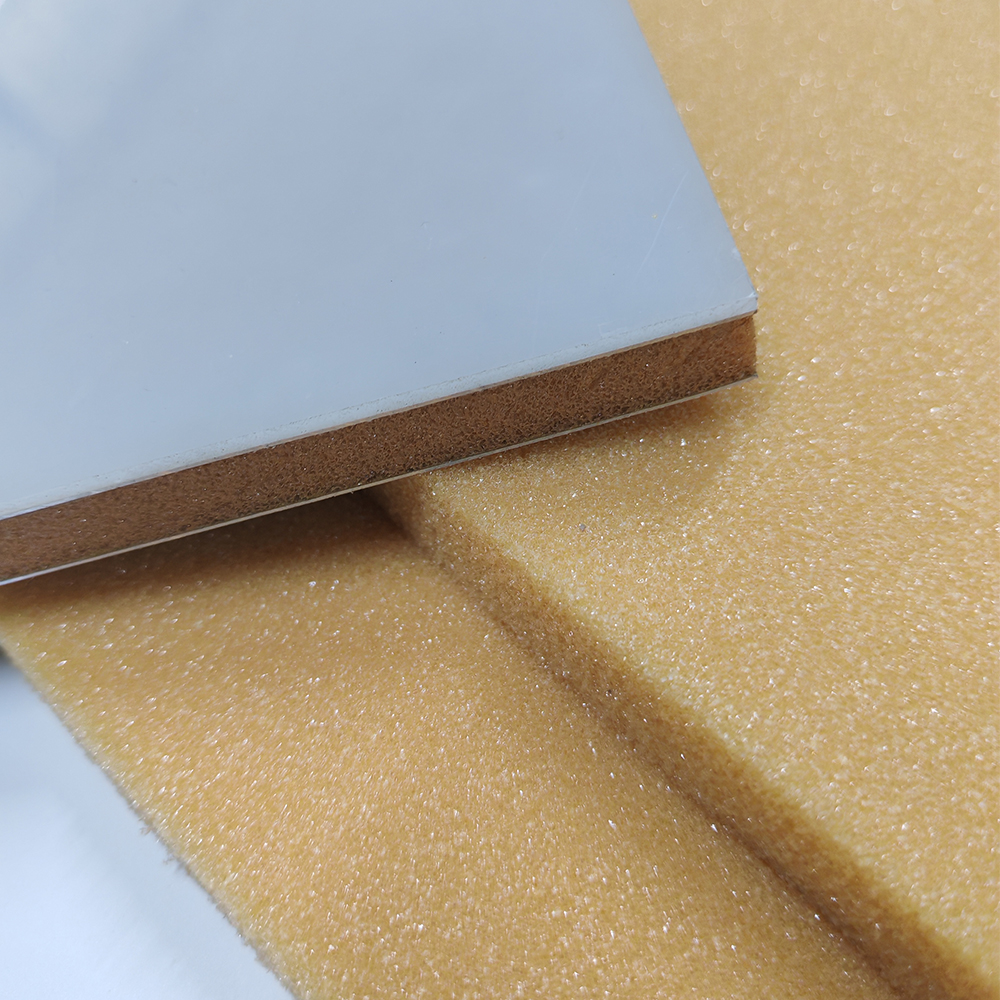
1. What Is PU Foam Core?
PU Foam Core, also known as Polyurethane Foam Core or Rigid Polyurethane Foam, is a lightweight cellular polymer material widely used in thermal insulation products and composite sandwich panels.
It is manufactured through a chemical reaction between polyol and isocyanate components. During the foaming process, a blowing agent creates a cellular structure, and the material expands and solidifies into a rigid foam.
Rigid PU foam typically has a closed-cell structure, which helps reduce heat transfer and limit moisture penetration. Its combination of low density, thermal insulation, compressive strength, and processing flexibility makes it suitable for a wide range of industrial applications.
In sandwich panel manufacturing, PU foam is commonly placed between two facing materials, such as color-coated steel, aluminum, FRP fiberglass, or other rigid sheets. The resulting structure combines the properties of the core and outer skins to provide insulation, rigidity, and reduced weight.
PU Foam Core is used in building insulation panels, cold storage panels, refrigerated truck bodies, industrial enclosures, and selected marine and transportation composite structures.
It is important to distinguish between insulation-grade PU foam and structural composite PU foam. Standard insulation foam is primarily designed for thermal performance, while specialized structural PU foam may be reinforced or formulated for higher mechanical loading.
2. Key Properties and Advantages of PU Foam Core
2.1 Excellent Thermal Insulation Performance
Thermal insulation is the most important advantage of rigid PU foam.
Its closed-cell structure contains insulating gas, which reduces heat transfer through the material. Commercial rigid PU insulation products commonly achieve thermal conductivity values around 0.021–0.026 W/(m·K), depending on formulation, density, blowing agent, aging, and testing conditions.
This makes PU foam an effective core material for applications requiring temperature control and energy efficiency.
Typical applications include:
- Cold storage wall and roof panels
- Refrigerated truck body panels
- Industrial insulation panels
- Building wall and roof sandwich panels
- Temperature-controlled equipment enclosures
2.2 Lightweight and High Compressive Strength
Rigid PU foam provides useful compressive performance at relatively low density.
Typical insulation-grade PU foam densities are around 30–45 kg/m³, although higher-density formulations are available for specialized applications.
Its compressive strength generally increases with density and formulation. This makes it suitable for sandwich panels where the core needs to support the facing materials and resist compressive loading.
For structural applications, buyers should also evaluate shear strength, tensile strength, bonding performance, and long-term fatigue behavior.
2.3 Closed-Cell Structure and Moisture Resistance
Rigid PU foam commonly has a high closed-cell content, which helps limit water absorption and water vapor movement.
This is particularly important for cold storage facilities, refrigerated vehicles, and industrial insulation systems.
However, moisture performance depends on foam formulation, cell structure, facing materials, joints, and installation quality. A PU foam core alone does not make the complete sandwich panel waterproof.
2.4 Good Bonding with Sandwich Panel Facings
PU foam is widely used in sandwich panel production because it can be formed between facing materials or bonded to prepared surfaces.
Depending on the manufacturing system, PU foam can be injected or foamed between metal sheets, laminated to FRP skins, or incorporated into customized panel structures.
A properly designed sandwich panel distributes loads through its outer skins and core. Bonding quality is therefore essential to prevent delamination and maintain panel performance.
2.5 Flexible Manufacturing and Customization
PU foam can be manufactured using different production methods, including continuous foaming, discontinuous panel production, molding, and block foaming.
This flexibility allows manufacturers to produce insulation boards, sandwich panels, molded components, and customized foam products.
Density, thickness, surface configuration, and facing materials can be selected according to the intended application.
3. PU Foam Core Technical Specifications
PU Foam Core is available in different grades for insulation and structural applications. The appropriate specification depends on the required thermal performance, compressive loading, panel design, and production process.
Typical Technical Parameters of Rigid PU Foam
| Property | Unit | Typical Reference Range |
|---|---|---|
| Material | – | Rigid Polyurethane (PUR) |
| Density | kg/m³ | 30–45 for common insulation grades |
| Higher-Density Options | kg/m³ | 50–200+, depending on formulation |
| Thickness | mm | Customized according to panel design |
| Thermal Conductivity | W/(m·K) | Approximately 0.021–0.026 |
| Compressive Strength | kPa | Approximately 100–250 for common insulation grades |
| Closed-Cell Content | % | Commonly above 90% |
| Water Absorption | % by volume | Product- and test-dependent |
| Surface | – | Plain, laminated, or molded |
| Processing | – | Foaming, molding, cutting, lamination, and bonding |
Note: The figures above are indicative market references for rigid PU foam products, not guaranteed ONEBOND product specifications. Mechanical properties and thermal conductivity depend on the formulation, density, manufacturing process, and test method.
Representative PU Foam Density and Performance by Application
| Application | Typical Density (kg/m³) | Representative Compressive Strength (kPa) |
|---|---|---|
| Building Insulation Boards | 30–35 | 130–175 |
| Refrigerators and Freezers | 32–35 | 120–160 |
| Insulated Sandwich Panels | 36–45 | 140–240 |
| Refrigerated Truck Panels | 45–80 | 180–450 |
| Industrial Pipe Insulation | 60–80 | Above 300 |
| Higher-Density Foam Blocks | 60–120+ | Depends on formulation and grade |
These are representative application ranges reported in technical literature. They are not a universal grading system. Actual performance must be confirmed using the supplier’s technical data sheet.
4. Main Applications of PU Foam Core
4.1 Building Insulation and Construction Sandwich Panels
Construction is one of the largest markets for rigid PU foam.
PU insulated sandwich panels generally consist of two metal facings with a rigid foam core in between. This structure combines thermal insulation with panel stiffness and relatively low weight.
Typical applications include:
- Exterior wall sandwich panels
- Roof insulation panels
- Industrial building enclosures
- Modular building systems
- Prefabricated construction panels
- Cleanroom wall and ceiling panels
PU sandwich panels are widely used in factories, warehouses, commercial buildings, and industrial facilities where thermal efficiency and fast installation are important.
4.2 Cold Storage and Refrigerated Facilities
PU Foam Core is particularly suitable for cold storage applications because of its low thermal conductivity.
Common applications include:
- Cold room wall panels
- Cold storage ceiling panels
- Refrigeration room partitions
- Freezer room panels
- Food processing facility enclosures
- Temperature-controlled warehouses
For these applications, panel thickness, joint design, vapor control, and thermal bridging must be considered together to achieve the required insulation performance.
4.3 Refrigerated Trucks and Trailer Manufacturing
Refrigerated vehicles require lightweight insulated structures that help maintain stable internal temperatures.
PU foam can be incorporated into FRP sandwich panels, aluminum-faced panels, and other insulated vehicle body structures.
Typical applications include:
- Refrigerated truck body panels
- Trailer wall and roof panels
- Insulated vehicle doors
- Cold-chain transportation compartments
- Mobile refrigeration equipment
The core density and panel structure should be selected according to vehicle loading, vibration, impact resistance, and thermal requirements.
4.4 Marine and Boat Building
Specialized PU foam products are also used in marine applications.
Reinforced structural polyurethane foam panels can be manufactured for boat components that require improved mechanical performance and reduced weight.
Potential applications include:
- Boat stringers
- Marine bulkheads
- Deck structures
- Interior sandwich panels
- Boat furniture components
- Lightweight marine partitions
Not all insulation-grade PU foam is suitable for structural marine use. Boat builders should select products specifically developed for composite manufacturing and verify resin compatibility, water resistance, bonding performance, and mechanical properties.
4.5 Industrial Equipment and Pipe Insulation
PU foam is also used in industrial thermal insulation systems.
Typical applications include:
- Industrial equipment insulation
- Insulated tanks and vessels
- District heating pipe insulation
- Refrigeration equipment
- Thermal protection enclosures
- Customized insulation components
For higher-temperature applications, the maximum service temperature and dimensional stability of the foam must be checked carefully.
5. PU Foam Manufacturing Process and Customization
PU Foam Core is manufactured through a controlled chemical foaming process.
The general production process includes:
Raw Material Preparation: Polyol, isocyanate, catalysts, surfactants, and blowing agents are prepared according to the required formulation.
Mixing and Foaming: The components are mixed in controlled proportions. A chemical reaction and gas generation create the foam structure.
Expansion and Curing: The foam expands to the required shape and density before curing and stabilizing.
Cutting and Shaping: Cured foam blocks or boards can be cut into specified dimensions and thicknesses.
Lamination and Panel Assembly: PU foam can be bonded to FRP, aluminum, steel, or other facing materials to produce insulated sandwich panels.
Common customized products include:
- PU Foam Board
- Rigid Polyurethane Foam Sheet
- PU Insulation Panel
- PU Sandwich Panel Core
- Laminated PU Foam Panel
- Customized Molded PU Foam Components
Manufacturing control is important for achieving consistent density, cell structure, dimensional stability, and mechanical performance.
6. PU Foam vs. PIR Foam vs. XPS Foam
PU, PIR, and XPS are commonly used in insulation and sandwich panel manufacturing. Although they share some applications, their chemical structures and performance characteristics differ.
| Comparison | PU Foam | PIR Foam | XPS Foam |
|---|---|---|---|
| Full Name | Polyurethane Foam | Polyisocyanurate Foam | Extruded Polystyrene Foam |
| Material Type | Thermoset polymer | Modified isocyanurate-based thermoset polymer | Thermoplastic polymer |
| Manufacturing | Chemical foaming reaction | Modified polyurethane-related reaction | Extrusion |
| Cell Structure | Mainly closed-cell | Mainly closed-cell | Closed-cell |
| Thermal Insulation | Excellent | Excellent | Very good |
| Fire Performance | Formulation-dependent | Generally improved compared with conventional PUR | Formulation-dependent |
| Typical Applications | Sandwich panels, cold storage, insulation | Fire-performance-focused insulation panels | Building insulation, tile backer boards |
| Main Selection Factor | Insulation and panel requirements | Insulation and specified fire performance | Moisture resistance and compressive insulation performance |
PIR is chemically related to polyurethane but uses a different formulation and a higher proportion of isocyanurate structures. It is often selected when improved fire performance is required.
However, neither PU nor PIR should automatically be described as fireproof. Fire classification must be supported by relevant product and assembly test reports.
7. How to Choose the Right PU Foam Core
Selecting a suitable PU Foam Core requires matching the material properties with the final product requirements.
Important factors include:
- Density: Choose the appropriate density according to insulation needs and mechanical loading.
- Thermal Conductivity: Compare declared thermal conductivity values under the same testing conditions.
- Compressive Strength: Confirm the required strength for the panel’s loading conditions.
- Closed-Cell Content: Review cell structure and moisture-related performance.
- Thickness: Determine the thickness according to the required thermal resistance and panel design.
- Facing Materials: Confirm compatibility with steel, aluminum, FRP, and other skins.
- Fire Performance: Check the required classification and applicable regional regulations.
- Operating Temperature: Confirm the material’s service temperature and dimensional stability.
- Manufacturing Process: Select a suitable grade for continuous foaming, molding, lamination, or cutting.
For sandwich panel manufacturers, finished-panel testing is essential. Core properties alone cannot determine the complete panel’s thermal, mechanical, or fire performance.
8. ONEBOND PU Foam Core Solutions
ONEBOND focuses on composite core materials, foam core products, and lightweight sandwich panel solutions for international industrial customers.
Our foam core product range includes PVC Foam, PET Foam, XPS Foam, PU Foam, PMI Foam, and other core materials for different industrial applications.
For PU Foam Core projects, buyers can discuss customized requirements such as:
- Density and thickness specifications
- Foam board dimensions
- Insulation-grade or specialized structural applications
- Customized cutting and shaping
- Laminated foam sandwich panels
- Application-specific material selection
Whether you are manufacturing cold storage panels, refrigerated truck bodies, industrial insulation boards, or customized composite panels, selecting the correct PU foam specification is essential to achieving reliable product performance.
Contact ONEBOND to discuss your PU Foam Core requirements and request technical information for your application.
9. Frequently Asked Questions About PU Foam Core
Q1: What is PU Foam Core used for?
PU Foam Core is widely used in insulated sandwich panels, cold storage rooms, refrigerated truck bodies, building insulation boards, industrial equipment enclosures, and selected marine composite structures.
Q2: What is the typical density of rigid PU foam?
Common insulation-grade rigid PU foam has a density of approximately 30–45 kg/m³. Higher-density grades are available for specialized applications, including structural components and industrial insulation.
Q3: What is the thermal conductivity of PU Foam Core?
Commercial rigid PU insulation products commonly have thermal conductivity values around 0.021–0.026 W/(m·K). The exact value depends on formulation, density, blowing agent, aging, and test conditions.
Q4: What is the difference between PU Foam and PIR Foam?
Both are rigid closed-cell insulation materials, but PIR has a modified chemical structure with a higher proportion of isocyanurate bonds. PIR is often selected for applications requiring improved fire performance. Actual fire classification must be verified through testing.
Q5: Can PU Foam Core be used in FRP sandwich panels?
Yes. Suitable PU foam grades can be bonded or laminated with FRP skins to produce lightweight insulated sandwich panels. For structural applications, manufacturers should verify bonding strength, shear performance, water resistance, and compatibility with the selected resin system.
Conclusion
PU Foam Core is an important material in modern insulation and sandwich panel manufacturing. Its low thermal conductivity, lightweight cellular structure, compressive performance, and flexible production methods make it suitable for construction, cold storage, refrigerated transportation, marine, and industrial applications.
As demand for energy-efficient buildings and temperature-controlled transportation continues to grow, rigid polyurethane foam remains a widely used insulation core material.
For manufacturers and procurement buyers, the key is to select the correct density, thermal conductivity, compressive strength, and panel configuration according to the actual application.
With appropriate material selection and quality control, PU Foam Core can provide an effective solution for insulated sandwich panels and customized lightweight structures.
