
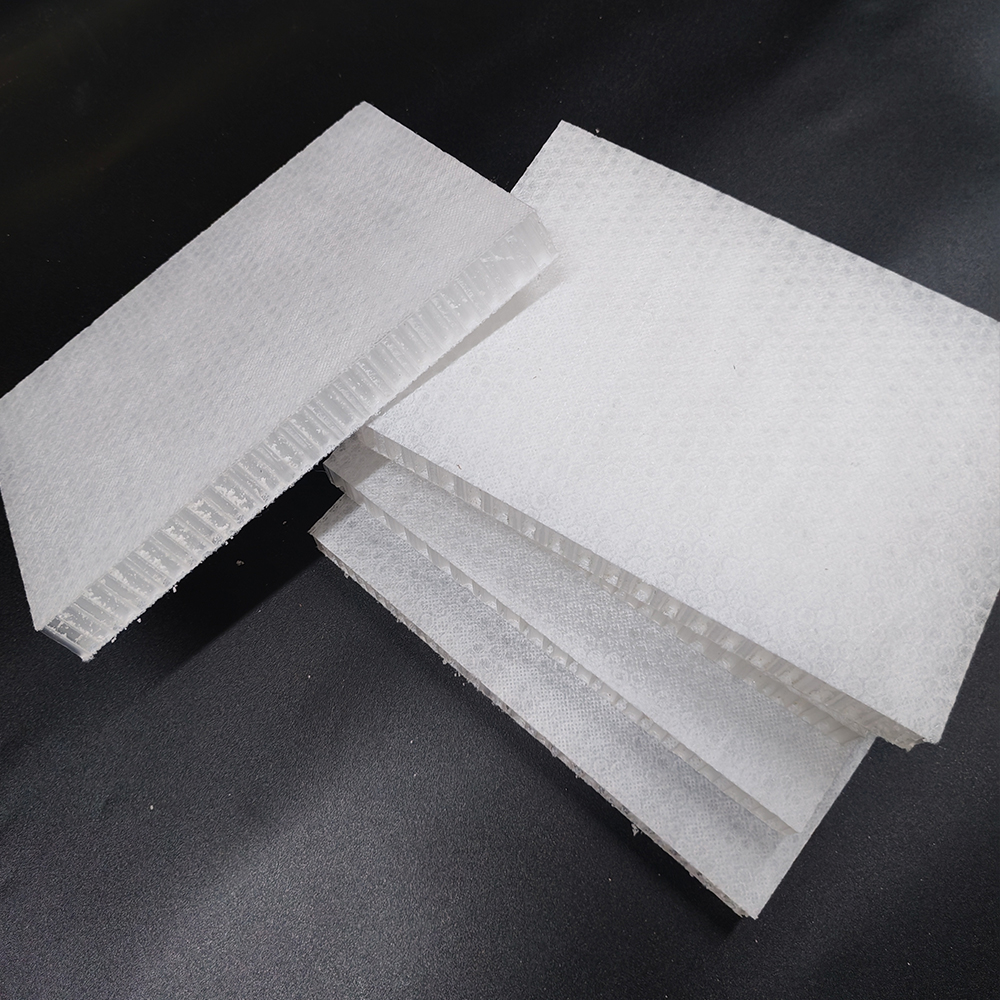
Polypropylene honeycomb core is widely used in lightweight sandwich structures because of its cellular design, low weight and versatility in composite panel manufacturing. However, not all PP honeycomb cores have the same surface configuration. For industrial buyers, one important purchasing decision is whether to choose bare PP honeycomb core or nonwoven faced PP honeycomb core.…
Polypropylene honeycomb core is widely used in lightweight sandwich structures because of its cellular design, low weight and versatility in composite panel manufacturing.
However, not all PP honeycomb cores have the same surface configuration.
For industrial buyers, one important purchasing decision is whether to choose bare PP honeycomb core or nonwoven faced PP honeycomb core.
Although both products use polypropylene as their primary structural material, their surface configurations are different. This difference can influence bonding processes, material compatibility, production efficiency and the final sandwich panel structure.
For manufacturers producing FRP composite panels, truck body panels, RV panels, marine interiors and industrial sandwich boards, understanding these differences is essential before selecting a core material.
This article explains the structural characteristics, bonding considerations, manufacturing compatibility and application differences between the two product types.
1. What Is Bare PP Honeycomb Core?
Bare PP honeycomb core is a polypropylene cellular material without an additional nonwoven fabric layer attached to its surface.
It consists primarily of a thermoplastic honeycomb structure with interconnected cell walls.
The open cellular structure provides a lightweight core configuration that can be incorporated into different sandwich panel designs.
1.1 Main Characteristics of Bare PP Honeycomb Core
The key characteristics include:
- Lightweight polypropylene cellular structure
- No additional nonwoven surface layer
- Customizable thickness and cell geometry
- Suitable for application-specific composite structures
- Flexible integration into different manufacturing processes
Because it does not contain an additional facing material, bare PP honeycomb core allows manufacturers to evaluate their own surface preparation, adhesive selection and lamination processes.
1.2 Typical Applications
Bare PP honeycomb core may be considered for:
- Composite panel manufacturing
- Industrial lightweight sandwich structures
- Customized FRP panel production
- Transportation composite components
- Applications involving specialized bonding or processing systems
The suitability of bare core depends on the compatibility between polypropylene and the selected adhesive, resin or facing material.
2. What Is Nonwoven Faced PP Honeycomb Core?
Nonwoven faced PP honeycomb core is a polypropylene honeycomb structure with a nonwoven fabric layer attached to one or both surfaces, depending on the product configuration.
The nonwoven layer creates an additional surface interface between the honeycomb structure and the materials used during composite panel manufacturing.
It is commonly considered when manufacturers need a more suitable surface configuration for lamination or bonding processes.
2.1 Main Characteristics of Nonwoven Faced PP Honeycomb Core
Its main characteristics include:
- Polypropylene honeycomb cellular structure
- Additional nonwoven fabric surface layer
- Different facing configurations available for evaluation
- Potentially improved compatibility with certain adhesive systems
- Suitable for composite panel manufacturing processes requiring a faced core
The actual bonding performance depends on the nonwoven material, its attachment to the PP core, the adhesive system and the facing materials.
A nonwoven layer does not automatically guarantee strong bonding. The complete interface must be validated through testing.
2.2 Typical Applications
Nonwoven faced PP honeycomb core may be evaluated for:
- FRP sandwich panels
- Fiberglass composite boards
- Truck body panels
- RV and caravan sandwich panels
- Lightweight transportation panels
- Industrial composite structures
For manufacturers using adhesive lamination or other composite manufacturing processes, the nonwoven surface may offer a useful alternative to bonding directly to bare polypropylene.
3. Bare PP Honeycomb Core vs Nonwoven Faced PP Honeycomb Core: Key Differences
The most important difference between these two products is their surface structure.
Bare PP honeycomb core exposes the polypropylene cellular structure, while nonwoven faced PP honeycomb core includes an additional fabric interface.
| Comparison | Bare PP Honeycomb Core | Nonwoven Faced PP Honeycomb Core |
|---|---|---|
| Main Material | Polypropylene | Polypropylene |
| Cellular Structure | PP Honeycomb | PP Honeycomb |
| Surface Configuration | Bare cellular surface | Nonwoven faced surface |
| Additional Facing | Not included | Nonwoven layer included |
| Surface Preparation | May require separate evaluation | Depends on facing and bonding system |
| Bonding Interface | Direct interface with PP surface | Interface involving nonwoven material |
| Processing Flexibility | Depends on customer’s process | Depends on facing and adhesive compatibility |
| Product Weight | Based on core structure | Includes additional facing weight |
| Cost Structure | No additional nonwoven layer | Includes facing material and processing |
| Application | Customized composite structures | Composite structures requiring a faced surface |
The selection should be based on the customer’s manufacturing process rather than the assumption that one product is universally superior.
4. Why Is Bonding PP Honeycomb Core Challenging?
One of the most important technical considerations in polypropylene honeycomb core manufacturing is surface bonding.
Polypropylene is a low-surface-energy thermoplastic. Many conventional adhesives and resins do not readily form reliable bonds with untreated PP surfaces.
This can create challenges when manufacturers attempt to bond PP honeycomb core directly with FRP skins, fiberglass sheets or other composite materials.
4.1 Low Surface Energy of Polypropylene
The chemical characteristics of polypropylene make it difficult for some adhesive systems to wet and adhere to untreated surfaces.
Potential problems include:
- Poor adhesive wetting
- Insufficient interfacial adhesion
- Inconsistent bonding quality
- Localized separation between the core and skin
- Reduced reliability under mechanical or environmental loading
The actual result depends on the adhesive chemistry, surface condition, processing temperature, pressure and curing conditions.
4.2 Why Does Surface Compatibility Matter?
In a sandwich panel, the core and facing skins work together as a structural system.
The skins carry a significant proportion of the tensile and compressive stresses during bending, while the core maintains separation between the skins and contributes to shear resistance.
If the bonding interface is weak, the panel may experience skin-to-core separation even when the individual core and skin materials have acceptable properties.
Therefore, core selection should always include an evaluation of the bonding system.
5. How Does Nonwoven Facing Help with PP Honeycomb Core Bonding?
Nonwoven facing provides an additional material layer on the surface of the polypropylene honeycomb core.
Depending on its material composition and structure, it may create a more suitable interface for certain adhesive or resin systems.
5.1 Creates an Additional Bonding Interface
Unlike bare PP honeycomb core, a nonwoven faced product provides a fabric surface that can be evaluated for compatibility with selected adhesives and composite skins.
This may be beneficial when the adhesive system is more compatible with the facing material than with untreated polypropylene.
5.2 Supports Composite Lamination Processes
During composite panel production, the facing layer may help integrate the core into a broader lamination process.
However, the performance depends on the nonwoven material, adhesive penetration, resin compatibility and processing conditions.
5.3 Provides More Surface Configuration Options
Nonwoven facing can be customized or selected according to different manufacturing requirements.
Important parameters include:
- Nonwoven material composition
- Fabric weight
- Fabric thickness
- Fiber structure
- Surface characteristics
- Facing attachment method
These parameters should be confirmed with the supplier before production.
5.4 Does Nonwoven Facing Eliminate the Need for Surface Treatment?
Not necessarily.
Nonwoven facing may provide an alternative bonding interface, but the attachment between the nonwoven fabric and the PP honeycomb core must also be reliable.
In some product configurations, additional surface treatment or a specialized bonding process may still be necessary.
The complete interface system should be tested rather than evaluating only the fabric-to-skin bond.
6. Bare vs Nonwoven Faced PP Honeycomb Core for FRP Sandwich Panels
FRP sandwich panels are an important application for polypropylene honeycomb core.
A typical FRP sandwich panel consists of:
- Top FRP skin
- Adhesive or bonding interface
- PP honeycomb core
- Adhesive or bonding interface
- Bottom FRP skin
The two core configurations can be evaluated according to the intended lamination process.
6.1 Using Bare PP Honeycomb Core with FRP Skins
Bare PP honeycomb core may be suitable when the manufacturer has an established bonding process for polypropylene.
The production team should verify:
- PP surface condition
- Adhesive chemistry
- Surface treatment requirements
- Bonding pressure and temperature
- Curing conditions
- Skin-to-core adhesion strength
Direct bonding should not be assumed to work with every conventional FRP resin or adhesive.
6.2 Using Nonwoven Faced PP Honeycomb Core with FRP Skins
Nonwoven faced PP honeycomb core may be considered when a fabric-based interface is more compatible with the selected lamination system.
For example, an adhesive system may bond more effectively to a particular nonwoven fabric than to untreated PP.
Before mass production, manufacturers should evaluate:
- Fabric and adhesive compatibility
- Adhesive penetration and distribution
- Nonwoven-to-PP attachment
- Skin-to-core bonding strength
- Panel surface quality
- Environmental durability
The final product should be tested using the actual FRP skin, adhesive and production conditions.
7. Which PP Honeycomb Core Is Better for Truck Body Panels?
Truck body panels require a combination of low weight, structural performance, durability and manufacturing consistency.
PP honeycomb core can be considered as the core material in lightweight composite panel structures, including panels with FRP skins.
The selection between bare and nonwoven faced core depends on the panel manufacturer’s production system.
| Selection Factor | Bare PP Honeycomb Core | Nonwoven Faced PP Honeycomb Core |
|---|---|---|
| Existing Bonding Process | Suitable when direct PP bonding has been validated | Suitable when the facing interface matches the adhesive system |
| Production Flexibility | Allows customer-specific surface preparation | Provides an additional surface configuration |
| Material Weight | No nonwoven facing weight | Additional facing weight must be considered |
| Composite Lamination | Requires direct interface evaluation | Requires nonwoven and adhesive compatibility evaluation |
| Cost Evaluation | Includes core material and any additional processing | Includes core, facing and facing attachment costs |
For truck body panel manufacturers, the most appropriate solution should be determined by the complete panel design, including skin material, panel dimensions, load requirements, bonding process and environmental conditions.
A small-scale production trial is recommended before adopting a new core configuration for large-volume manufacturing.
8. Which PP Honeycomb Core Is Better for RV and Marine Panels?
RV and marine composite panel applications have different operating environments, but both often require lightweight construction and reliable bonding.
8.1 RV and Caravan Panels
RV manufacturers commonly use sandwich panel structures for walls, roofs, floors and interior components.
When selecting PP honeycomb core, manufacturers should consider:
- Total panel weight
- Core thickness
- Skin material
- Panel dimensions
- Bonding compatibility
- Temperature exposure
- Long-term dimensional stability
Nonwoven faced core may be useful when its surface is compatible with the panel lamination process.
8.2 Marine Composite Panels
Marine applications require additional attention to moisture exposure, structural loading and environmental durability.
Although polypropylene itself has relatively low water absorption, the performance of a complete sandwich panel depends on the skins, bonding interfaces, edges, joints and other construction details.
For marine panels, buyers should evaluate:
- Water exposure conditions
- Skin-to-core adhesion
- Edge sealing
- Mechanical loading
- Temperature and humidity exposure
- Applicable marine fire and safety requirements
Neither bare nor nonwoven faced PP honeycomb core should be selected solely based on the core material’s moisture characteristics.
9. How to Choose Between Bare and Nonwoven Faced PP Honeycomb Core
Before placing an order, composite panel manufacturers should evaluate five important factors.
9.1 Existing Manufacturing Process
If your production line already has a validated bonding solution for polypropylene, bare PP honeycomb core may be a suitable option.
If your process requires a different surface interface, nonwoven faced core may be worth evaluating.
9.2 Adhesive and Resin Compatibility
Identify the adhesive or resin system used in your production.
The bonding system should be compatible with the PP surface or the selected nonwoven facing.
9.3 Core Specifications
Both configurations should be compared using equivalent specifications:
- Apparent density
- Core thickness
- Cell size
- Cell wall thickness
- Areal weight
- Sheet dimensions
For a fair comparison, confirm whether the stated weight includes the nonwoven facing.
9.4 Finished Panel Performance
Do not evaluate the core material alone.
Test the complete panel structure for relevant properties such as:
- Flatwise compression
- Core shear
- Skin-to-core adhesion
- Flexural performance
- Impact resistance
- Environmental durability
9.5 Total Manufacturing Cost
A lower-priced bare core does not necessarily result in a lower total production cost.
Additional surface treatment, adhesive consumption, processing time and quality control should all be considered.
Similarly, nonwoven faced core may add material and processing costs but could simplify certain manufacturing steps.
The correct comparison is the total cost of producing a qualified finished panel.
10. PP Honeycomb Core Customization Options from ONEBOND
ONEBOND provides composite core material solutions for manufacturers serving transportation, construction, marine and industrial markets.
For polypropylene honeycomb core, product configurations can be evaluated according to the customer’s application and production requirements.
Available customization discussions may include:
Core structure
- Bare PP Honeycomb Core
- Nonwoven Faced PP Honeycomb Core
- Customized honeycomb cell configuration
Dimensional specifications
- Core thickness
- Cell size
- Sheet width
- Sheet length
- Dimensional tolerances
Surface configuration
- Bare cellular surface
- Nonwoven facing
- Customized facing requirements
Application requirements
- FRP sandwich panels
- Truck body panels
- RV and caravan panels
- Marine composite panels
- Industrial lightweight panels
For an accurate recommendation, customers should provide their panel structure, adhesive system, processing method and target performance requirements.
ONEBOND can then evaluate the suitable core configuration and discuss the corresponding technical specifications.
Contact ONEBOND to discuss bare or nonwoven faced PP honeycomb core for your composite panel production.
Frequently Asked Questions
Q1: What is the difference between bare PP honeycomb core and nonwoven faced PP honeycomb core?
Bare PP honeycomb core has an exposed polypropylene cellular surface, while nonwoven faced PP honeycomb core includes an additional nonwoven fabric layer attached to one or both surfaces.
Q2: Why is nonwoven faced PP honeycomb core used in FRP sandwich panels?
Nonwoven facing can provide an additional bonding interface that may be more compatible with certain adhesive systems and composite lamination processes.
Q3: Can bare PP honeycomb core be bonded directly to FRP skins?
It may be possible with a validated adhesive and surface preparation system, but direct bonding to untreated polypropylene should not be assumed to work with every FRP resin or adhesive.
Q4: Does nonwoven facing increase PP honeycomb core weight?
Yes. The additional nonwoven fabric contributes to the total product weight, so buyers should confirm whether the quoted areal weight includes the facing.
Q5: Is nonwoven faced PP honeycomb core always stronger than bare PP honeycomb core?
No. Overall panel performance depends on the core structure, facing materials, adhesive system, bonding quality and complete panel design.
Q6: Can ONEBOND supply customized PP honeycomb core with nonwoven facing?
ONEBOND can evaluate customized nonwoven faced PP honeycomb core configurations according to the required dimensions, facing specifications and application conditions. Specific configurations should be confirmed before ordering.
