
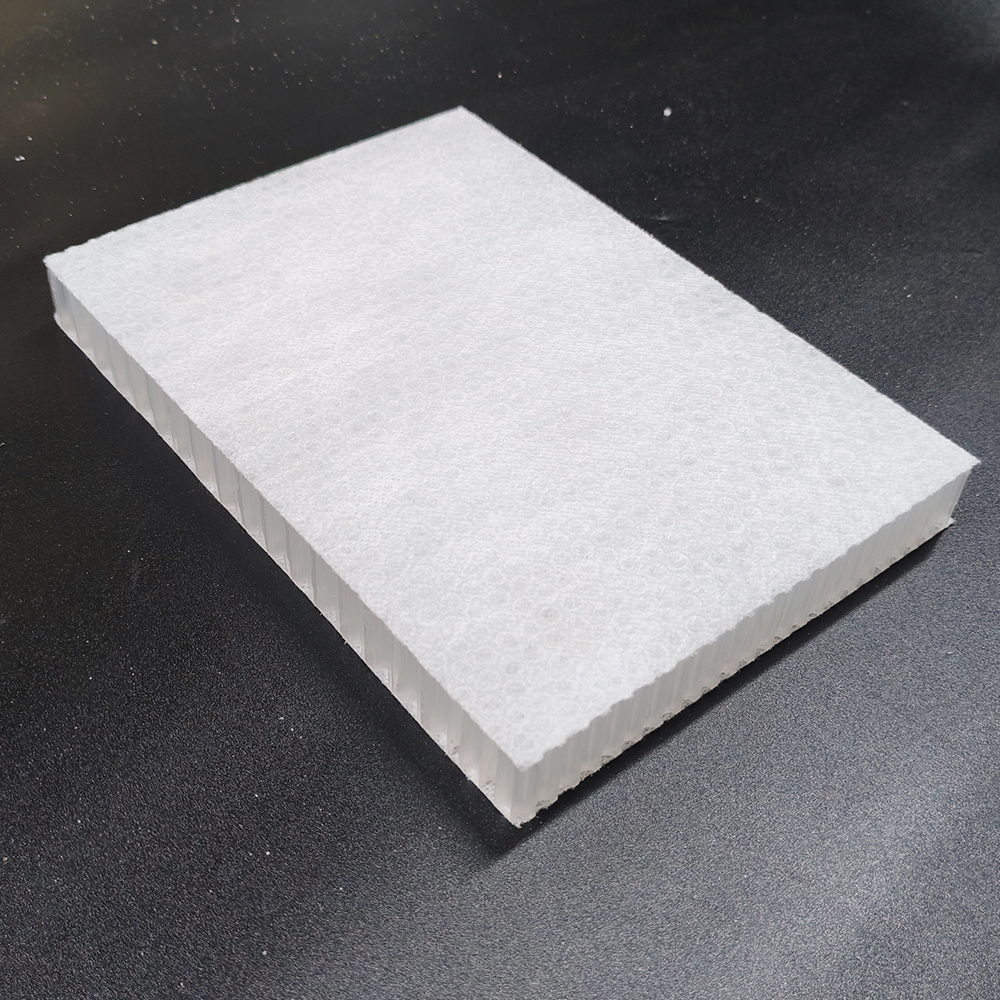
How to Choose the Right PP Honeycomb Core for Composite Panels: A Complete Selection Guide Choosing the right PP honeycomb core is an important engineering and purchasing decision in composite panel manufacturing. Polypropylene honeycomb core is used in lightweight sandwich structures for transportation, construction, marine, RV and industrial applications. Its cellular structure offers opportunities to…
How to Choose the Right PP Honeycomb Core for Composite Panels: A Complete Selection Guide
Choosing the right PP honeycomb core is an important engineering and purchasing decision in composite panel manufacturing.
Polypropylene honeycomb core is used in lightweight sandwich structures for transportation, construction, marine, RV and industrial applications. Its cellular structure offers opportunities to reduce panel weight while maintaining the structural depth required by a sandwich construction.
However, selecting a suitable core is not simply a matter of choosing the lowest density or the thickest available material.
A PP honeycomb core that performs well in one composite panel may not be suitable for another. Differences in skin materials, adhesive systems, panel dimensions, loading conditions and manufacturing processes can significantly affect the final result.
For procurement managers, choosing the wrong core specification can lead to unnecessary material costs, bonding problems, production delays and inconsistent finished panel quality.
For composite engineers, the challenge is to balance mechanical performance, weight, manufacturability and total production cost.
This guide explains how to select PP honeycomb core systematically, from application analysis and material specifications to bonding compatibility, mechanical testing and supplier evaluation.
1. Start with the Final Composite Panel Application
Before comparing PP honeycomb core specifications, identify the application of the finished panel.
Different industries have different structural requirements, manufacturing processes and operating environments.
A lightweight interior panel does not necessarily require the same core configuration as a truck body panel or marine composite structure.
1.1 PP Honeycomb Core for Truck Body Panels
Truck body panels are commonly designed as lightweight sandwich structures with FRP or other facing materials.
Typical selection priorities include:
- Low overall panel weight
- Adequate compression and shear performance
- Panel bending stiffness
- Skin-to-core bonding reliability
- Impact and vibration resistance
- Production consistency
- Dimensional compatibility with panel manufacturing equipment
For truck body panels, the core should be evaluated together with the panel span, skin construction, fastening details and expected service loads.
1.2 PP Honeycomb Core for FRP Composite Panels
FRP sandwich panels use fiberglass-reinforced polymer skins combined with a lightweight cellular core.
Important selection considerations include:
- Compatibility between the core and FRP manufacturing process
- Adhesive or resin compatibility
- Core thickness
- Cell geometry
- Surface configuration
- Finished panel flexural and shear performance
Polypropylene has relatively low surface energy, so direct bonding to untreated PP should not be assumed to work with every adhesive or resin system.
Surface treatment, nonwoven facing or a specially selected adhesive system may need to be evaluated.
1.3 PP Honeycomb Core for RV and Caravan Panels
RV and caravan manufacturers often prioritize lightweight construction and efficient panel production.
Typical requirements include:
- Weight reduction
- Consistent core thickness
- Compatibility with interior and exterior skins
- Panel dimensional stability
- Bonding reliability
- Resistance to expected temperature and humidity conditions
The core specification should be selected according to the complete wall, roof, floor or interior panel design.
1.4 PP Honeycomb Core for Marine Composite Panels
Marine applications require careful consideration of moisture exposure, structural loading and environmental durability.
Although polypropylene itself has relatively low water absorption, the complete sandwich panel also includes skins, adhesive interfaces, edges and joints.
Important selection factors include:
- Core shear and compression properties
- Skin-to-core adhesion
- Edge sealing
- Water exposure conditions
- Temperature and humidity
- Fire and marine regulatory requirements, where applicable
The final material system should be validated for the intended marine application.
2. Select the Right PP Honeycomb Core Density
Density is one of the first specifications buyers usually request.
For PP honeycomb core, apparent density is generally expressed in kilograms per cubic meter (kg/m³).
It represents the mass of the cellular structure divided by its external volume. It should not be confused with the solid density of polypropylene resin.
2.1 How Does Density Affect Core Selection?
Apparent density is related to the amount of polymer material contained in a given volume of honeycomb core.
When other structural characteristics are comparable, increasing density may improve resistance to compression or shear deformation.
However, density alone cannot determine the mechanical performance of a honeycomb core.
Two PP honeycomb cores with similar apparent density may behave differently because of variations in:
- Cell size
- Cell wall thickness
- Cell geometry
- Material distribution
- Polymer grade
- Manufacturing consistency
2.2 Density and Material Weight
For a core with uniform apparent density, theoretical areal weight can be estimated using:
Core Areal Weight = Apparent Density × Core Thickness
For example, consider a hypothetical core with:
- Apparent density: 80 kg/m³
- Core thickness: 20 mm (0.020 m)
The estimated core areal weight is:
80 × 0.020 = 1.6 kg/m².
This calculation excludes additional facing materials, adhesives and other surface treatments.
When comparing suppliers, buyers should confirm whether the quoted weight includes nonwoven facing.
2.3 How Should Buyers Specify Density?
Instead of asking only for a high-density or low-density core, provide the supplier with the required panel weight, loading conditions and target mechanical properties.
A manufacturer can then evaluate whether the requested density and cellular configuration are technically suitable.
3. Choose the Correct PP Honeycomb Core Thickness
Core thickness is a major design parameter because it determines the distance between the two outer skins in a sandwich panel.
This distance has a significant influence on the structural behavior of the finished panel.
3.1 Why Is Thickness Important?
In a sandwich structure, the two skins carry much of the tensile and compressive stresses during bending.
The core separates these skins and contributes to shear resistance.
Increasing core thickness can improve bending stiffness in a properly designed panel, but it also increases core volume and, at a given density, core weight.
3.2 Match Core Thickness with Panel Design
For example, a sandwich panel may consist of:
| Component | Example Thickness |
|---|---|
| Top FRP Skin | 2 mm |
| PP Honeycomb Core | 20 mm |
| Bottom FRP Skin | 2 mm |
| Total Panel Thickness | 24 mm |
These are illustrative dimensions, not standard ONEBOND specifications.
The actual core thickness should be determined according to:
- Panel dimensions
- Unsupported span
- Expected loads
- Skin material and thickness
- Required panel stiffness
- Manufacturing tolerances
- Installation requirements
A thicker core is not automatically better if the panel design does not require the additional structural depth.
4. Select the Appropriate PP Honeycomb Cell Size
Cell size describes the characteristic dimensions of the individual honeycomb cells.
It is an important structural specification because the geometry of the cells influences material distribution and deformation behavior.
4.1 How Does Cell Size Affect the Final Panel?
Cell size can influence:
- Cellular geometry
- Local support for facing materials
- Cell wall configuration
- Load distribution
- Adhesive and resin interaction
- Manufacturing compatibility
However, smaller cells do not automatically mean higher strength.
The actual mechanical performance depends on cell size, wall thickness, apparent density, cell orientation and manufacturing quality.
4.2 Cell Size and Facing Material Compatibility
The relationship between cell size and facing material should be considered during composite panel design.
For example, the selected FRP skin, adhesive system and lamination method may require a particular surface configuration or support arrangement.
The supplier should be given sufficient information about the intended facing materials and processing method before a cell size is finalized.
4.3 What Should Buyers Ask About Cell Size?
When requesting a quotation, clarify:
- Nominal cell size
- Cell size measurement method
- Cell geometry
- Cell wall thickness, if available
- Dimensional consistency
- Whether the specified cell size applies to the finished product
This avoids misunderstandings between different manufacturers’ specification systems.
5. Choose Between Bare PP Honeycomb Core and Nonwoven Faced PP Honeycomb Core
Surface configuration is another important factor in core selection.
The two common product configurations are bare PP honeycomb core and nonwoven faced PP honeycomb core.
5.1 Bare PP Honeycomb Core
Bare core has an exposed polypropylene cellular surface without an additional nonwoven fabric layer.
It may be suitable when the panel manufacturer has an established bonding or surface preparation process for polypropylene.
Potential advantages include:
- No additional nonwoven facing weight
- Simpler surface configuration
- Flexibility for customized surface treatment
- Direct evaluation of the PP cellular surface
However, bonding to untreated PP can be challenging for some adhesive systems.
5.2 Nonwoven Faced PP Honeycomb Core
Nonwoven faced core includes an additional fabric layer attached to one or both surfaces.
Depending on the nonwoven material and adhesive system, it may provide a more suitable bonding interface for composite panel manufacturing.
Important specifications include:
- Nonwoven material composition
- Fabric weight
- Fabric thickness
- Facing configuration
- Attachment method
- Compatibility with the selected adhesive
Nonwoven facing does not automatically guarantee strong bonding. The nonwoven-to-PP interface and skin-to-facing interface must both be evaluated.
5.3 Comparison for Procurement Decisions
| Selection Factor | Bare PP Honeycomb Core | Nonwoven Faced PP Honeycomb Core |
|---|---|---|
| Surface | Exposed PP cellular surface | Nonwoven fabric facing |
| Additional Weight | No nonwoven layer | Includes facing weight |
| Bonding Approach | Requires suitable PP bonding solution | Requires compatible fabric and adhesive system |
| Surface Treatment | May require separate treatment | Depends on facing configuration |
| Production Compatibility | Depends on existing process | Depends on lamination process |
| Cost Evaluation | Core plus any additional treatment | Core plus facing and attachment processing |
The correct option should be selected through production trials and bonding tests.
6. Match PP Honeycomb Core with the Right Facing Materials
The outer skins are a major part of the sandwich panel structure.
The selected core must be compatible with the material, thickness and manufacturing process of these skins.
6.1 FRP and Fiberglass Skins
FRP skins are commonly used in lightweight transportation and industrial composite panels.
When combining PP honeycomb core with FRP skins, buyers should evaluate:
- Fiberglass reinforcement type
- FRP skin thickness
- Resin system
- Adhesive chemistry
- Surface treatment
- Nonwoven facing compatibility
- Lamination temperature and pressure
A compatible bonding system is essential for reliable panel performance.
6.2 Aluminum Skins
Aluminum skins may be used in lightweight composite structures requiring metallic exterior surfaces.
Important considerations include:
- Aluminum alloy and surface condition
- Adhesive compatibility
- Thermal expansion differences
- Corrosion-related design considerations
- Bonding pressure and curing conditions
The interface between the aluminum skin and PP honeycomb core should be validated with the selected adhesive system.
6.3 Other Facing Materials
Depending on the application, sandwich panel skins may also include:
- Thermoplastic sheets
- Decorative laminates
- Wood-based panels
- Fiber-reinforced composite sheets
- Other engineered facing materials
Each material combination requires its own bonding and processing evaluation.
A core that works with one skin material should not automatically be assumed compatible with another.
7. Select the Right Adhesive and Bonding Process
Bonding is one of the most important technical considerations when using PP honeycomb core in composite panels.
Polypropylene has relatively low surface energy, which can limit the wetting and adhesion of conventional adhesives.
Therefore, the bonding system should be selected based on the actual materials and production conditions.
7.1 Common Bonding Considerations
The following factors should be evaluated:
Adhesive chemistry
The adhesive must be compatible with polypropylene or the selected nonwoven facing, as well as the outer skin material.
Surface treatment
Depending on the product and adhesive, plasma, corona, flame treatment or other surface preparation methods may be evaluated.
Nonwoven facing
A suitable nonwoven layer may provide an alternative bonding interface, but the fabric-to-core attachment must also be reliable.
Adhesive application
Adhesive distribution, application weight and coverage can affect bonding consistency.
Temperature and pressure
Processing temperature, pressing pressure and curing time must follow the adhesive manufacturer’s requirements and remain compatible with the core and facing materials.
7.2 How to Verify Bonding Quality
A practical validation process should include:
- Confirming material compatibility.
- Preparing representative core and skin specimens.
- Producing samples with the intended adhesive and process.
- Evaluating skin-to-core adhesion.
- Recording the failure mode.
- Conducting environmental conditioning where necessary.
- Repeating the test under production-representative conditions.
The objective is not simply to achieve a high initial bond strength, but to establish reliable bonding under the expected operating environment.
8. Select Core Properties According to Load Requirements
The mechanical requirements of the final panel should determine the core specification.
Different applications may involve compression, shear, bending, impact or long-term loading.
8.1 Compression Requirements
Flatwise compression properties are important when the panel may experience pressure perpendicular to its surface.
Examples include:
- Localized support loads
- Fastening and mounting areas
- Contact pressure
- Distributed compressive loading
The core should be evaluated for compression strength and deformation behavior.
8.2 Shear Requirements
Core shear properties are important because the core transfers shear forces between the outer skins.
This is particularly relevant in sandwich panels subjected to bending.
For long panels or structures with significant unsupported spans, shear deformation and core shear failure may become important design considerations.
8.3 Flexural Requirements
Flexural performance is a property of the complete sandwich structure.
It depends on:
- Skin material and thickness
- Core thickness
- Core shear properties
- Bonding quality
- Panel dimensions
- Support and loading conditions
A core with good compression properties does not necessarily produce a sandwich panel with high bending performance.
8.4 Impact and Long-Term Loading
Transportation and marine panels may experience repeated vibration, impact and long-term loading.
Depending on the application, manufacturers may need to evaluate:
- Impact resistance
- Fatigue behavior
- Creep deformation
- Environmental durability
- Temperature-related changes in mechanical performance
The appropriate tests should be selected according to actual service conditions.
9. Match PP Honeycomb Core with the Manufacturing Process
A suitable core specification must also work with the customer’s production equipment and manufacturing process.
Even when the core meets the required mechanical properties, incompatibility with production equipment can create difficulties.
9.1 Adhesive Lamination
In adhesive lamination, the core is bonded to the facing skins through a selected adhesive system.
Important considerations include:
- Surface configuration
- Adhesive application method
- Pressing pressure
- Curing temperature
- Curing time
- Panel flatness
The process should avoid excessive pressure or temperature that could damage or deform the cellular structure.
9.2 Vacuum-Assisted Composite Processing
Some composite manufacturing processes use vacuum pressure to consolidate the laminate.
For PP honeycomb core, manufacturers should evaluate:
- Core stability under the applied pressure
- Resin compatibility
- Resin flow and distribution
- Cell structure protection
- Facing configuration
- Final panel consolidation
The core must be suitable for the actual pressure and temperature conditions used during production.
9.3 Press Lamination
Press lamination can provide efficient production for composite sandwich panels.
However, pressing conditions must be controlled.
Excessive pressure may cause cellular deformation, while unsuitable temperature conditions may affect core dimensional stability.
9.4 Cutting and Machining
Core thickness, sheet dimensions and cellular configuration should be compatible with the cutting and machining equipment.
Buyers should confirm:
- Required sheet dimensions
- Cutting tolerances
- Edge quality
- Processing direction
- Material handling requirements
Production trials are useful for identifying possible dimensional or machining issues before mass production.
10. Use a Complete Sandwich Panel Testing Program
One of the most important mistakes in material selection is relying only on the mechanical properties of the core.
A finished sandwich panel consists of multiple materials that work together.
Even if the core passes an independent compression test, the complete panel may still fail because of poor bonding, weak skins or manufacturing defects.
10.1 Core-Level Testing
The following tests can help characterize the core:
| Test | Main Evaluation |
|---|---|
| Apparent Density Test | Mass per unit volume |
| Flatwise Compression Test | Core compression properties |
| Core Shear Test | Core shear strength and modulus |
| Thickness Measurement | Dimensional consistency |
| Water Absorption Test | Water absorption under defined conditions |
Relevant ASTM references include C271/C271M, C365/C365M, C273/C273M, C366/C366M and C272/C272M.
10.2 Complete Sandwich Panel Testing
For the finished panel, testing should consider the interaction of the core, facing skins and adhesive interfaces.
| Test | Main Evaluation |
|---|---|
| Sandwich Beam Flexure | Panel bending response and core shear behavior |
| Flatwise Tensile Test | Through-thickness tensile and bonding performance |
| Facesheet Flexure | Facing material performance |
| Edgewise Compression | In-plane compression behavior |
| Impact Test | Resistance to impact loading |
| Environmental Conditioning | Performance after specified environmental exposure |
Relevant ASTM references may include C393/C393M, C297/C297M, D7249/D7249M and C364/C364M.
The correct testing program depends on the panel design and intended application.
10.3 Why Is Failure Mode Important?
A numerical result alone does not provide a complete picture of material performance.
For example:
- Core crushing indicates a compression-related failure.
- Core shear rupture indicates a failure within the cellular core.
- Skin-to-core separation indicates an interface problem.
- Facing rupture indicates a failure within the outer skin.
Recording failure location and appearance helps engineers determine whether the core, adhesive or facing material controls the panel performance.
11. A Practical PP Honeycomb Core Selection Checklist for Buyers
Before sending an RFQ to a manufacturer, prepare the following information.
| Category | Information Required |
|---|---|
| Application | Truck body, FRP panel, RV, marine or industrial panel |
| Core Material | Polypropylene honeycomb |
| Apparent Density | Target kg/m³ or required areal weight |
| Core Thickness | Required mm |
| Cell Size | Required cell dimension and measurement method |
| Cell Wall Thickness | Required value, if specified |
| Surface Configuration | Bare or nonwoven faced |
| Facing Material | FRP, fiberglass, aluminum or other materials |
| Bonding Method | Adhesive lamination, vacuum-assisted process or other method |
| Mechanical Requirements | Compression, shear, flexure or impact |
| Sheet Dimensions | Required width and length |
| Manufacturing Process | Pressing, lamination, cutting or other processing |
| Quality Requirements | Dimensional tolerances and applicable test standards |
| Order Information | Quantity, sample requirements and delivery destination |
Providing complete information makes it easier for the manufacturer to recommend a suitable core configuration and prepare an accurate quotation.
12. How to Evaluate a PP Honeycomb Core Manufacturer
Choosing a reliable manufacturer is as important as choosing the right specification.
A supplier should be able to discuss material properties, customization, manufacturing consistency and application compatibility.
12.1 Technical Specification Capability
Ask whether the manufacturer can provide information about:
- Apparent density
- Core thickness
- Cell size
- Cell wall structure
- Areal weight
- Dimensional tolerances
- Surface configuration
12.2 Customization Capability
Different panel manufacturers have different production requirements.
A suitable supplier should be able to evaluate customized dimensions and surface configurations according to product feasibility.
12.3 Quality Control
Ask how the manufacturer controls:
- Core thickness
- Sheet dimensions
- Weight consistency
- Cellular structure
- Surface quality
- Product uniformity
Where available, request inspection records and representative test reports.
12.4 Application Experience
A manufacturer familiar with FRP sandwich panels, transportation panels and industrial composite structures may be better positioned to understand application-specific requirements.
However, application experience should be supported by relevant product samples, technical documentation and validated testing rather than general marketing claims.
13. Customized PP Honeycomb Core Solutions from ONEBOND
ONEBOND focuses on composite core materials and lightweight sandwich panel solutions for international industrial customers.
We understand that selecting PP honeycomb core is part of a larger composite panel engineering process.
The core must match the customer’s dimensions, skin materials, bonding system, mechanical requirements and manufacturing conditions.
ONEBOND can evaluate customized product configurations based on:
Core specifications
- Apparent density
- Core thickness
- Cell size
- Cellular structure
- Sheet dimensions
Surface configurations
- Bare PP Honeycomb Core
- Nonwoven Faced PP Honeycomb Core
- Customized facing requirements
Application requirements
- FRP sandwich panels
- Truck body panels
- RV and caravan panels
- Marine composite panels
- Industrial lightweight panels
Technical evaluation
- Compression requirements
- Shear requirements
- Bonding compatibility
- Processing conditions
- Finished panel performance
Our goal is to help composite panel manufacturers identify a suitable core configuration instead of simply supplying a material based on one specification number.
Contact ONEBOND to discuss your application, request customized PP honeycomb core specifications and evaluate the right material for your composite panel production.
Frequently Asked Questions
Q1: How do I choose the right PP honeycomb core for composite panels?
Start with the final panel application, then evaluate density, thickness, cell size, facing materials, bonding method, mechanical requirements and manufacturing conditions.
Q2: What density should I choose for PP honeycomb core?
The appropriate density depends on the required panel weight, core geometry, compression and shear requirements, and complete sandwich panel design. Density should not be selected independently.
Q3: What PP honeycomb core thickness is suitable for FRP sandwich panels?
Core thickness depends on panel dimensions, skin construction, unsupported span, loading conditions and required stiffness. The final thickness should be established through structural design and production trials.
Q4: Should I choose bare or nonwoven faced PP honeycomb core?
Choose bare core when a validated bonding process for polypropylene is available. Consider nonwoven faced core when its fabric interface is more compatible with the selected adhesive and lamination process.
Q5: Can PP honeycomb core be bonded directly to FRP skins?
It may be possible with a validated adhesive and surface preparation system. However, untreated polypropylene has low surface energy, so direct bonding should be tested rather than assumed.
Q6: Which mechanical properties should be considered when selecting PP honeycomb core?
Important properties include flatwise compression strength, compression modulus, shear strength, shear modulus and, where relevant, impact and creep behavior.
Q7: Is PP honeycomb core suitable for truck body panels?
PP honeycomb core can be considered for lightweight truck body sandwich panels, particularly when combined with compatible FRP skins and a validated bonding system. The complete panel must meet the required structural and durability criteria.
Q8: Why should the complete sandwich panel be tested?
Complete panel testing evaluates the combined performance of the core, skins and bonding interfaces. Independent core tests cannot fully predict finished panel bending, adhesion or structural performance.
Q9: What information should I provide when requesting a PP honeycomb core quotation?
Provide the application, target density, thickness, cell size, surface configuration, skin material, bonding method, mechanical requirements, sheet dimensions and expected order quantity.
Q10: Can ONEBOND customize PP honeycomb core for different composite panel applications?
ONEBOND can evaluate customized PP honeycomb core configurations according to the customer’s application, dimensional requirements, surface configuration and manufacturing process. Specific specifications and production feasibility should be confirmed before ordering.
