
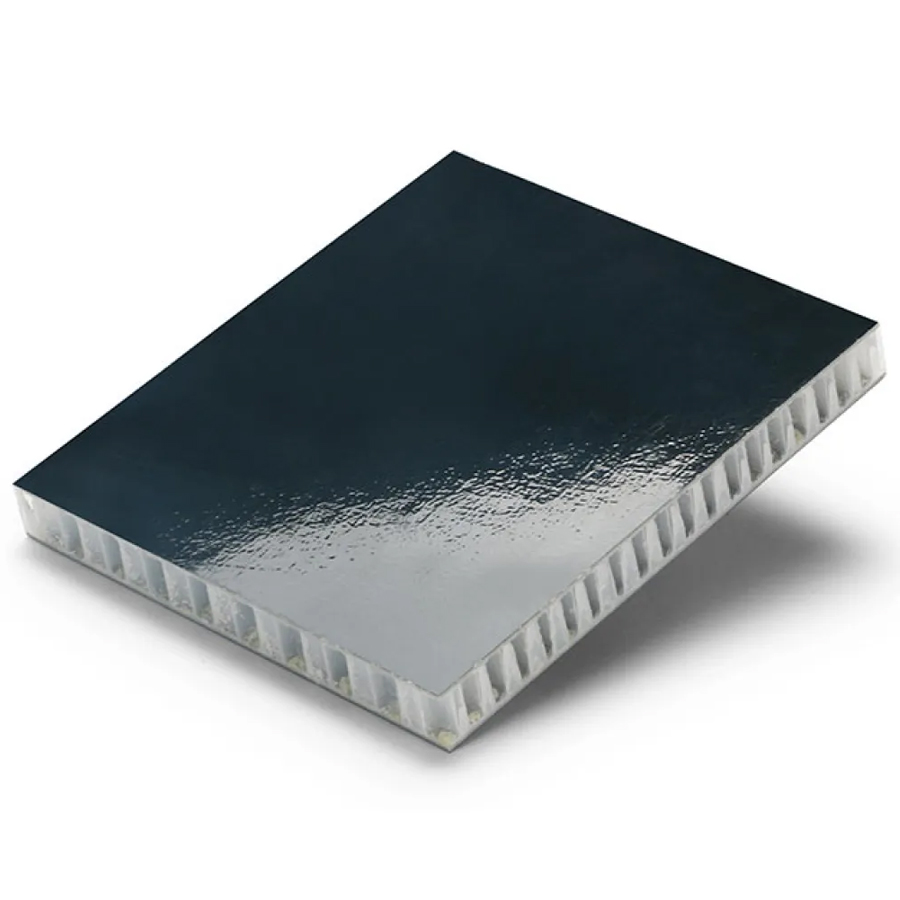
FRP Panel with PP Honeycomb Core: Structure, Benefits and Industrial Applications
1. Introduction: Why Combine FRP Skins with PP Honeycomb Core?
FRP panels with PP honeycomb core are lightweight composite structures designed for applications where weight reduction, panel stiffness and manufacturing flexibility are important.
This type of panel combines fiberglass-reinforced plastic (FRP) skins with a polypropylene (PP) honeycomb core. The FRP skins provide protective surfaces and contribute to the panel’s bending performance, while the honeycomb core maintains the separation between the skins and transfers shear loads.
The resulting sandwich structure can be considered for truck body panels, trailer walls, RV components, marine interiors and other industrial composite applications.
For manufacturers, the combination of FRP and PP honeycomb offers an alternative to conventional solid panels and selected foam-core sandwich structures.
However, successful panel production requires more than selecting a lightweight core. Core geometry, skin construction, bonding compatibility, lamination conditions and finished-panel testing all influence the final result.
This guide explains the structure, benefits, technical considerations and industrial applications of FRP panels with PP honeycomb core.
2. What Is an FRP Panel with PP Honeycomb Core?
An FRP panel with PP honeycomb core is a sandwich composite panel made by bonding two fiberglass-reinforced plastic skins to a polypropylene honeycomb core.
A typical structure includes:
- Outer FRP skin
- Bonding interface
- PP honeycomb core
- Bonding interface
- Inner FRP skin
The two FRP skins form the outer surfaces of the panel. The PP honeycomb core provides a lightweight cellular structure between them.
Depending on the production process, the core can be supplied as a bare honeycomb sheet or with a nonwoven facing layer.
The panel can also be customized in terms of core thickness, cell size, density or areal weight, skin thickness, dimensions and surface finish.
The exact configuration should be determined according to the finished panel’s application and performance requirements.
3. Structure of an FRP PP Honeycomb Sandwich Panel
Understanding the function of each layer is essential when developing a reliable composite panel.
3.1 FRP Outer Skin
The FRP skin is the external layer of the sandwich structure.
It is generally made from fiberglass reinforcement combined with a polymer resin system.
Common reinforcement materials include:
- Fiberglass chopped strand mat
- Woven roving
- Continuous strand mat
- Fiberglass fabric
Common resin systems include:
- Polyester resin
- Vinyl ester resin
- Epoxy resin
The selection depends on the required mechanical properties, surface appearance, environmental exposure, temperature and manufacturing process.
The FRP skin performs several functions:
- Provides the outer protective surface
- Contributes to tensile and compressive resistance
- Helps determine the bending performance of the complete panel
- Protects the core from direct environmental exposure
- Allows different surface finishes and panel designs
Skin thickness, fiberglass reinforcement, resin content and laminate quality should be considered together.
3.2 PP Honeycomb Core
The polypropylene honeycomb core is the central structural component.
It consists of a cellular structure formed from thermoplastic polypropylene.
Its main functions include:
- Maintaining the distance between the FRP skins
- Supporting the sandwich structure
- Transferring shear loads
- Contributing to compression resistance
- Reducing panel weight compared with certain solid constructions
The mechanical performance of PP honeycomb core depends on several factors, including:
- Apparent density
- Core thickness
- Cell size
- Cell wall geometry
- Material distribution
- Manufacturing consistency
Different core configurations can produce different mechanical responses. Buyers should evaluate the actual core specifications rather than relying on the material name alone.
3.3 Bonding Interface
The bonding interface connects the PP honeycomb core to the FRP skins.
This is particularly important because polypropylene has relatively low surface energy.
Many conventional adhesives and resins do not reliably bond to untreated PP surfaces without appropriate surface preparation or a compatible interface system.
Depending on the application, possible solutions include:
- Plasma treatment
- Corona treatment
- Flame treatment
- Nonwoven facing
- Qualified adhesive systems
- Other validated surface preparation methods
For nonwoven-faced PP honeycomb core, two interfaces should be evaluated separately:
- PP honeycomb core to nonwoven facing
- Nonwoven facing to FRP skin
The use of a nonwoven layer does not automatically guarantee sufficient bonding strength. Actual lamination trials and mechanical testing are recommended.
4. Bare PP Honeycomb Core vs Nonwoven Faced PP Honeycomb Core
PP honeycomb core is available in different surface configurations.
The two common options are bare PP honeycomb core and nonwoven-faced PP honeycomb core.
| Comparison | Bare PP Honeycomb Core | Nonwoven Faced PP Honeycomb Core |
|---|---|---|
| Core Surface | Exposed PP cellular structure | PP honeycomb with nonwoven facing |
| Surface Configuration | Bare thermoplastic surface | Additional fabric-like facing layer |
| Bonding Consideration | Direct bonding requires careful evaluation | Facing-to-skin bonding must be validated |
| Processing | May require additional surface preparation | Can provide an alternative bonding interface |
| Customization | Cell size, thickness and density | Core specifications plus facing configuration |
| Typical Evaluation | Surface treatment and adhesive compatibility | Facing integrity and two-interface bonding |
4.1 When to Consider Bare PP Honeycomb Core
Bare PP honeycomb core may be suitable when the panel manufacturer has an established surface treatment and bonding process.
It can offer flexibility for manufacturers who prefer to control the bonding process themselves.
Before mass production, the manufacturer should confirm:
- Surface preparation requirements
- Adhesive or resin compatibility
- Bonding strength
- Lamination conditions
- Long-term interface durability
4.2 When to Consider Nonwoven Faced PP Honeycomb Core
Nonwoven-faced PP honeycomb core may be considered when an additional facing layer is useful for the selected lamination process.
The facing can provide a different surface for bonding to the FRP skin.
However, manufacturers should verify the facing material, attachment to the PP core and compatibility with the selected adhesive or resin.
The correct choice depends on the customer’s equipment, production method and target panel structure.
5. Key Benefits of FRP Panels with PP Honeycomb Core
5.1 Lightweight Sandwich Construction
Weight reduction is one of the main reasons manufacturers evaluate PP honeycomb core.
The cellular structure allows the core to occupy a relatively large volume without using a solid block of polymer material.
When combined with appropriately designed FRP skins, it can help produce lightweight sandwich panels.
For transportation manufacturers, lower panel weight may contribute to improved payload efficiency and easier material handling.
However, the actual weight of the finished panel depends on the core, skins, adhesive, coatings and additional structural components.
5.2 Structural Efficiency
The separation between the two FRP skins is an important feature of sandwich construction.
During bending, one skin generally carries tensile stress while the opposite skin carries compressive stress.
The core maintains the separation between the skins and transfers shear loads.
A properly designed sandwich panel can therefore achieve useful bending stiffness relative to its weight.
Actual performance must be evaluated using the complete panel configuration.
5.3 Thermoplastic Core Material
PP honeycomb core is based on polypropylene, a thermoplastic polymer.
Polypropylene offers characteristics such as:
- Low material density
- Good chemical resistance to many substances
- Low water absorption
- Thermoplastic processing flexibility
- Corrosion-free cellular construction
These characteristics make PP honeycomb worth evaluating for various industrial composite applications.
Nevertheless, temperature limits, fire behavior, long-term creep and chemical compatibility should be assessed for the intended operating environment.
5.4 Flexible Panel Design
FRP panels with PP honeycomb core can be developed with different:
- Core thicknesses
- Cell sizes
- Density or areal weight
- FRP skin configurations
- Facing materials
- Panel dimensions
- Surface finishes
This flexibility supports different panel designs and industrial manufacturing requirements.
5.5 Potential for Industrial Customization
Composite panel manufacturers often have their own production equipment, adhesive systems and finished-product specifications.
A customized PP honeycomb core configuration can be developed around the customer’s manufacturing process.
For example, the manufacturer may require a particular core thickness, cell size, sheet dimension or nonwoven facing configuration.
The final specification should be confirmed through sample evaluation and production trials.
6. Technical Specifications for FRP PP Honeycomb Panels
When developing an FRP panel with PP honeycomb core, buyers should evaluate both the core specifications and the complete panel structure.
6.1 PP Honeycomb Core Specifications
| Parameter | Description | Purchasing Consideration |
|---|---|---|
| Material | Polypropylene (PP) | Confirm material grade and consistency |
| Core Thickness | Overall honeycomb core thickness | Match the required finished panel thickness |
| Cell Size | Nominal honeycomb cell dimension | Consider structural requirements and processing |
| Density | Apparent core density | Evaluate together with thickness and mechanical properties |
| Areal Weight | Core weight per unit area | Useful for panel weight calculations |
| Facing | Bare or nonwoven faced | Match the bonding process |
| Sheet Dimensions | Length and width | Match cutting and lamination equipment |
| Thickness Tolerance | Permitted dimensional variation | Confirm with the supplier |
| Surface Condition | Core and facing quality | Check for damage and inconsistencies |
6.2 FRP Skin Specifications
| Parameter | Description |
|---|---|
| Fiberglass Reinforcement | Chopped strand mat, woven roving or fabric |
| Resin Type | Polyester, vinyl ester or epoxy |
| Skin Thickness | Nominal thickness of each FRP skin |
| Surface Finish | Smooth, textured, coated or customized |
| Color | According to project requirements |
| Mechanical Requirements | Tensile, flexural and impact performance |
| Environmental Requirements | Moisture, chemical, temperature and UV exposure |
6.3 Finished Panel Specifications
The complete panel should be evaluated using:
- Total panel thickness
- Total panel weight
- Bending stiffness
- Core shear performance
- Flatwise tensile performance
- Compression resistance
- Impact response
- Bonding durability
- Dimensional stability
These properties depend on the entire sandwich structure and should not be inferred solely from the PP honeycomb core specifications.
7. Industrial Applications of FRP Panels with PP Honeycomb Core
7.1 Truck Body Panels
Truck body manufacturing is an important application to evaluate for lightweight FRP honeycomb sandwich structures.
Potential applications include:
- Truck body side walls
- Front panels
- Rear doors
- Roof panels
- Interior partitions
- Selected floor and structural components
For truck body manufacturers, the main considerations include:
- Total panel weight
- Bending stiffness
- Impact resistance
- Fastener and joint design
- Moisture protection
- Bonding durability
- Production efficiency
The core, skins and panel structure should be designed around the actual loading conditions of the vehicle.
For heavily loaded floors or high-impact areas, additional structural reinforcement or a different panel configuration may be required.
7.2 Trailer Manufacturing
FRP sandwich panels are used in various trailer body designs.
A PP honeycomb core can be evaluated for:
- Side wall panels
- Front wall panels
- Roof panels
- Interior partitions
The suitability depends on structural loading, support spacing, skin construction, fastening methods and operating conditions.
7.3 RV and Caravan Manufacturing
Recreational vehicles require lightweight materials to help control overall vehicle weight.
Potential applications include:
- RV side walls
- Roof structures
- Interior partitions
- Cabinet and furniture panels
- Lightweight doors
For RV manufacturers, important selection factors include weight, insulation requirements, moisture resistance, surface finish and long-term bonding performance.
Where thermal insulation is a priority, the panel designer should evaluate whether PP honeycomb alone meets the required thermal performance or whether an additional insulation layer is needed.
7.4 Marine Interior Applications
FRP composite panels can be considered for selected marine interior components.
Potential applications include:
- Cabin partitions
- Interior wall panels
- Lightweight furniture
- Decorative structures
- Selected non-critical interior components
Marine applications require careful consideration of fire performance, smoke requirements, moisture exposure, fatigue, impact and applicable marine regulations.
PP honeycomb core should not be assumed suitable for every marine structural application without the necessary engineering and approval process.
7.5 Industrial Composite Panels
FRP and PP honeycomb structures can also be evaluated for:
- Equipment covers
- Lightweight enclosures
- Modular components
- Industrial partitions
- Customized composite boards
The panel structure should match the specific load, temperature and environmental conditions.
8. Manufacturing Considerations for FRP PP Honeycomb Panels
A reliable FRP PP honeycomb panel requires coordinated control of materials and production parameters.
8.1 Material Compatibility
The FRP skin, PP honeycomb core and bonding system must be compatible.
This should be confirmed before production through material testing and sample lamination.
8.2 Adhesive Application
The bonding material should be applied uniformly according to its technical requirements.
Excessive or insufficient adhesive can affect panel weight, bonding consistency and finished quality.
8.3 Pressing Conditions
Pressing pressure and temperature should be suitable for the selected core and adhesive.
Excessive pressure may deform the honeycomb structure, while insufficient pressure may cause incomplete contact.
8.4 Curing Conditions
Curing time and temperature should follow the adhesive or resin system’s technical requirements.
The panel should not be released prematurely if the bonding system has not developed sufficient strength.
8.5 Finished Panel Inspection
Inspection should include:
- Visual appearance
- Panel thickness
- Length and width
- Flatness
- Bonding condition
- Core deformation
- Mechanical performance where required
For critical applications, complete sandwich panel testing should be performed under representative conditions.
9. How to Choose an FRP PP Honeycomb Panel Supplier
Selecting a reliable material supplier is important for manufacturers planning long-term production.
Buyers should evaluate the following areas.
9.1 Core Manufacturing Capability
Check whether the supplier can provide the required PP honeycomb core configuration, including thickness, cell size, density and facing options.
9.2 Product Consistency
Ask about dimensional tolerances, raw material control, batch consistency and inspection procedures.
9.3 Customization Capability
A suitable supplier should be able to discuss the required specifications and confirm which customization options are supported.
9.4 Technical Communication
The supplier should understand the customer’s application and be able to discuss core configuration, surface characteristics and bonding considerations.
9.5 Sample and Production Validation
Before placing a large order, buyers should evaluate samples and conduct production trials using their actual FRP skins, adhesive system and equipment.
10. Why Choose ONEBOND PP Honeycomb Core?
ONEBOND focuses on composite core materials for lightweight sandwich panel manufacturing.
Our product range includes:
- Bare PP Honeycomb Core
- Nonwoven Faced PP Honeycomb Core
- Customized PP Honeycomb Sheets
- PVC Foam Core
- PET Foam Core
- XPS Foam Core
- PU Foam Core
Our PP honeycomb core products can be evaluated for FRP sandwich panels, truck body panels, trailer structures, RV panels and other industrial composite applications.
We understand that different panel manufacturers have different requirements for:
- Core thickness
- Cell size
- Density or areal weight
- Facing configuration
- Sheet dimensions
- Cutting requirements
ONEBOND supports customized material discussions based on confirmed technical specifications and manufacturing capabilities.
If you are developing an FRP panel with PP honeycomb core, we recommend sharing your panel structure, adhesive system and intended application so that the core configuration can be evaluated more accurately.
Contact ONEBOND to discuss your PP honeycomb core requirements for FRP composite panel manufacturing.
11. Frequently Asked Questions
Q1: What is an FRP panel with PP honeycomb core?
It is a sandwich composite panel consisting of fiberglass-reinforced plastic skins bonded to a polypropylene honeycomb core.
Q2: Is PP honeycomb core suitable for FRP sandwich panels?
Yes. It can be used in FRP sandwich panel designs, provided that the bonding interface, material compatibility and complete panel performance are properly evaluated.
Q3: What is the difference between bare and nonwoven-faced PP honeycomb core?
Bare PP honeycomb has an exposed polypropylene surface, while nonwoven-faced PP honeycomb includes an additional facing layer that may provide an alternative bonding interface.
Q4: Why is bonding PP honeycomb core to FRP skins difficult?
Polypropylene has relatively low surface energy, which can make direct bonding with conventional adhesives and resins difficult. Surface treatment or a suitable facing and adhesive system may be required.
Q5: Can FRP PP honeycomb panels be used for truck bodies?
They can be evaluated for truck body side walls, roof panels, doors and other components, subject to structural design, load requirements and testing.
Q6: Are FRP PP honeycomb panels waterproof?
FRP skins and PP honeycomb core can offer useful moisture resistance, but the finished panel’s water resistance also depends on bonding, edge sealing, joints and surface condition.
Q7: What specifications are important when purchasing PP honeycomb core?
Important specifications include thickness, cell size, density or areal weight, facing configuration, sheet dimensions and dimensional tolerances.
Q8: Can ONEBOND provide customized PP honeycomb core?
ONEBOND can discuss customized PP honeycomb core configurations according to confirmed product requirements and manufacturing capabilities.
Q9: How can manufacturers verify FRP PP honeycomb panel quality?
They should evaluate dimensions, bonding integrity, core compression, shear properties and the mechanical performance of the complete sandwich panel using suitable test methods.
Q10: Is PP honeycomb core suitable for marine applications?
It can be considered for selected marine composite applications, but fire, smoke, moisture, fatigue and regulatory requirements must be assessed for the specific vessel and component.
Conclusion
FRP panels with PP honeycomb core combine fiberglass-reinforced skins with a lightweight polypropylene cellular structure.
This sandwich construction can be considered for truck bodies, trailers, RVs, marine interiors and industrial composite products where weight reduction and structural efficiency are important.
Successful manufacturing depends on more than the core material itself. FRP skin design, bonding compatibility, core configuration, lamination conditions and finished panel testing must all be considered.
ONEBOND supplies PP honeycomb core and other composite core materials for manufacturers developing customized FRP sandwich panel solutions.
