
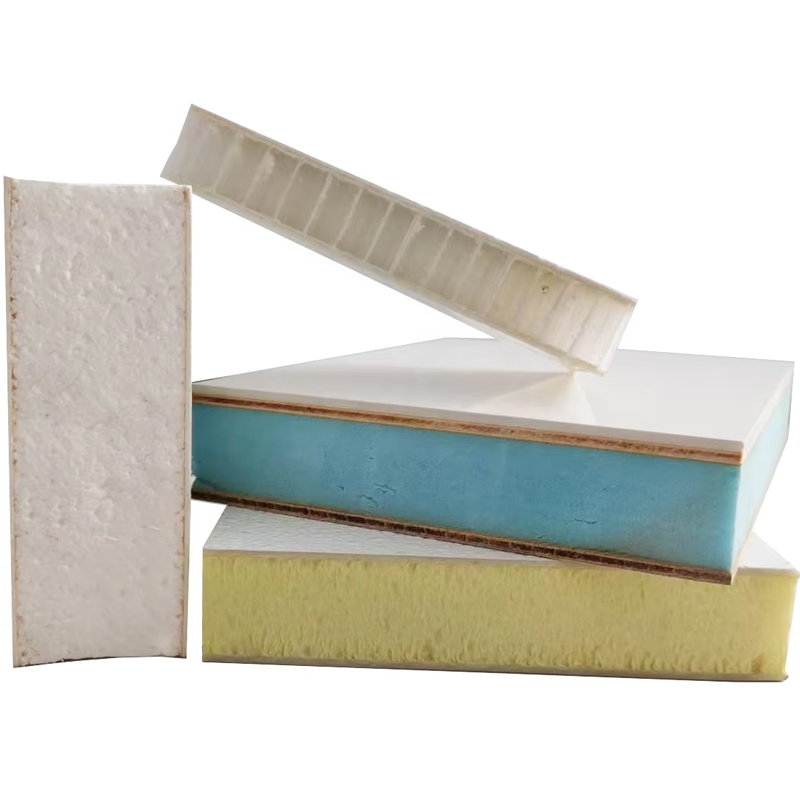
How to Manufacture FRP Truck Body Panels: Core Materials, Bonding Process and Quality Control
SEO Title: How to Manufacture FRP Truck Body Panels: Materials and Process
Meta Description: Learn how to manufacture FRP truck body panels, including core preparation, FRP skin bonding, pressing, curing, cutting and quality control.
URL: /how-to-manufacture-frp-truck-body-panels/
Primary Keyword: FRP Truck Body Panel Manufacturing
Secondary Keywords:
- FRP Truck Body Panel Manufacturing Process
- FRP Sandwich Panel Production
- Truck Body Composite Panel Manufacturing
- FRP Panel Bonding Process
- PP Honeycomb Core for Truck Body
- PET Foam Core for FRP Panels
- PVC Foam Core for Composite Panels
- Lightweight Truck Body Panel Production
- Composite Sandwich Panel Quality Control
1. Introduction: Understanding FRP Truck Body Panel Manufacturing
FRP sandwich panels are widely considered for truck bodies, trailers and other transportation applications because they combine lightweight construction with structural performance and design flexibility.
A typical FRP truck body panel consists of two FRP face sheets bonded to a lightweight core material. Depending on the application, the core may be PP honeycomb, PET foam, PVC foam, PU foam or another suitable structural material.
However, manufacturing a reliable FRP sandwich panel involves more than simply placing a core between two FRP sheets.
The quality of the finished panel depends on several interconnected factors:
- FRP skin quality and thickness
- Core material properties and surface condition
- Adhesive or resin compatibility
- Bonding pressure and curing conditions
- Panel alignment and dimensional accuracy
- Edge reinforcement and local inserts
- Final mechanical and environmental performance
For truck body panel manufacturers, a stable manufacturing process is essential for producing panels with consistent quality, predictable performance and reliable production efficiency.
This article explains the major stages of FRP truck body panel manufacturing, from raw material preparation to final inspection.
2. Understanding the Structure of an FRP Truck Body Sandwich Panel
Before discussing the production process, it is important to understand the basic sandwich structure.
A typical FRP truck body panel contains five main layers:
| Layer | Material | Main Function |
|---|---|---|
| Outer skin | FRP Sheet | Exterior protection and structural contribution |
| Bonding layer | Adhesive or Resin | Transfers loads between skin and core |
| Core | PP Honeycomb / PET Foam / PVC Foam | Maintains skin separation and transfers shear |
| Bonding layer | Adhesive or Resin | Connects the core to the inner skin |
| Inner skin | FRP Sheet | Interior surface and structural contribution |
The two FRP face sheets provide much of the panel’s bending resistance, while the core maintains their separation and transfers shear forces.
This structure helps create a lightweight panel with useful stiffness and strength characteristics.
However, the actual mechanical performance depends on the complete sandwich construction, not simply the properties of the individual core material.
Common FRP Truck Body Panel Applications
- Truck side wall panels
- Truck roof panels
- Front wall panels
- Rear door panels
- Trailer wall panels
- Refrigerated truck panels
- Cargo compartment partitions
- Lightweight vehicle interior panels
Different applications require different panel structures and performance targets.
For example, a truck floor panel may require greater resistance to concentrated loads and repeated impact than a typical side wall panel.
3. Step 1: Selecting the Right Core Material
Core selection is one of the earliest and most important decisions in FRP sandwich panel manufacturing.
Different materials provide different combinations of weight, mechanical properties, bonding requirements and processing characteristics.
3.1 PP Honeycomb Core
PP Honeycomb Core is a lightweight thermoplastic material with a regular cellular structure.
Its main advantages include:
- High lightweight potential
- Low moisture absorption associated with polypropylene
- Cellular structure with a high void ratio
- Potential for large-area sandwich panels
- Different cell sizes and thickness configurations
PP honeycomb is often evaluated for lightweight truck side walls, roofs, partitions and other large-area panels.
Manufacturing consideration: Polypropylene has relatively low surface energy. Direct bonding to FRP should not be assumed to provide reliable adhesion.
Depending on the product configuration, manufacturers may need suitable surface treatment, compatible adhesives, nonwoven facing or other validated bonding solutions.
For nonwoven-faced PP honeycomb, both the core-to-facing interface and facing-to-FRP interface should be tested.
3.2 PET Foam Core
PET Foam Core features a relatively uniform cellular structure and is used in various structural composite applications.
Potential benefits include:
- Uniform foam structure
- Different density grades
- Good processing flexibility
- Compatibility with suitable adhesive and resin systems
- Potential balance between weight and structural performance
PET foam can be considered for side walls, roof panels, partitions and selected flooring structures.
The final selection should be based on the technical properties of the specific PET foam grade.
3.3 PVC Foam Core
PVC Foam Core is a rigid structural foam material commonly used in sandwich composite manufacturing.
Its characteristics include:
- Rigid cellular structure
- Multiple density grades
- Structural sandwich panel applications
- Machining and shaping potential
- Compatibility with suitable composite bonding systems
PVC foam may be selected where a particular combination of stiffness, compression resistance and processing characteristics is required.
Core Material Selection Table
| Selection Factor | PP Honeycomb | PET Foam | PVC Foam |
|---|---|---|---|
| Weight reduction | Strong potential | Density dependent | Density dependent |
| Core structure | Honeycomb cells | Cellular foam | Cellular foam |
| Compression behavior | Geometry dependent | Grade dependent | Grade dependent |
| Shear performance | Structure and bonding dependent | Grade dependent | Grade dependent |
| Bonding requirements | Requires special attention | System compatibility required | System compatibility required |
| Machining | Depends on cell structure and facing | Suitable methods available | Suitable methods available |
| Typical consideration | Lightweight large panels | Balanced structural performance | Rigid structural applications |
The correct core should be selected according to panel design, production technology and service requirements.
4. Step 2: Preparing the FRP Skin and Core Material
Material preparation has a direct influence on final bonding quality.
Before assembly, manufacturers should inspect the FRP skins and core materials to confirm that they meet the required specifications.
FRP Skin Preparation
Important inspection points include:
- Skin thickness
- Surface cleanliness
- Surface flatness
- Visible cracks or defects
- Surface contamination
- Dimensional accuracy
Dust, oil, release agents and other contaminants may affect adhesive performance.
The surface should be prepared according to the requirements of the selected adhesive or resin system.
Core Material Preparation
The core material should be checked for:
- Thickness consistency
- Density consistency
- Surface condition
- Flatness
- Edge damage
- Dimensional accuracy
- Moisture condition where relevant to the material and process
For foam cores, manufacturers should check whether the surface condition is suitable for the selected adhesive.
For PP honeycomb, additional attention should be paid to the facing configuration and surface treatment.
Customized Core Cutting
Truck body panels often require customized dimensions.
Core materials may need to be cut according to the final panel design.
Common requirements include:
- Length and width
- Core thickness
- Cell size for honeycomb
- Density for foam
- Facing configuration
- Edge treatment
- Openings and cutouts
Accurate cutting helps improve assembly consistency and reduces unnecessary material waste.
5. Step 3: Selecting the Adhesive or Resin System
The bonding system is a critical component of FRP sandwich panel manufacturing.
A suitable adhesive must provide reliable bonding between the FRP skin and the selected core material under the intended service conditions.
Different core materials may require different bonding approaches.
Common Bonding Considerations
| Material Combination | Important Considerations |
|---|---|
| FRP + PP Honeycomb | Surface energy, surface treatment, facing and adhesive compatibility |
| FRP + PET Foam | Foam surface condition, adhesive compatibility and curing |
| FRP + PVC Foam | Adhesive selection, surface preparation and curing conditions |
| FRP + PU Foam | Compatibility with the foam grade and manufacturing process |
| FRP + Aluminum Honeycomb | Surface preparation, adhesive distribution and interface durability |
The bonding system should be evaluated together with the actual FRP skin and core material.
Adhesive Selection Factors
Manufacturers should consider:
- Adhesive compatibility with both materials
- Required bond strength
- Working time and open time
- Curing temperature
- Curing time
- Application method
- Environmental and service conditions
- Production speed and equipment capability
The adhesive supplier’s technical data and recommendations should be followed.
There is no single adhesive or resin system that is suitable for every FRP sandwich panel.
6. Step 4: Applying Adhesive and Assembling the Sandwich Panel
Once the skins and core are prepared, the next stage is adhesive application and panel assembly.
The process depends on the selected materials and production equipment.
A general assembly sequence may include:
1. Position the lower FRP skin
Place the first FRP sheet on a clean and level production surface.
2. Apply the bonding material
Apply adhesive or resin according to the validated process parameters.
The distribution should be sufficiently uniform to avoid dry areas and excessive adhesive accumulation.
3. Position the core material
Place the prepared core on the lower skin and align it according to the panel dimensions.
4. Apply the upper bonding layer
Apply the required bonding material to the upper core surface or upper skin, depending on the manufacturing method.
5. Position the upper FRP skin
Place the second FRP sheet carefully to complete the sandwich structure.
6. Check panel alignment
Confirm the overall dimensions, edge alignment and surface condition before pressing.
Why Adhesive Distribution Matters
Insufficient adhesive coverage may result in weak bonding or local delamination.
Excessive adhesive may increase panel weight, raise material costs and create uneven bonding thickness.
A controlled application process helps maintain consistent panel quality.
7. Step 5: Pressing and Curing
Pressing and curing are important stages in the manufacturing process.
The objective is to establish the required bonding between the face sheets and core while maintaining the designed panel thickness and flatness.
Depending on the material system, manufacturers may use:
- Flat press equipment
- Vacuum pressing systems
- Roller pressing equipment
- Other suitable panel bonding systems
Key Process Parameters
| Parameter | Why It Matters |
|---|---|
| Pressing pressure | Influences contact and bonding |
| Pressing time | Must match the adhesive curing requirements |
| Temperature | Affects adhesive reaction and material stability |
| Panel thickness | Determines final dimensional accuracy |
| Pressure distribution | Helps prevent uneven bonding |
| Curing conditions | Influence final bond properties |
These parameters must be determined through adhesive technical data, material limitations and production trials.
Excessive pressure may crush or deform a lightweight core.
Insufficient pressure may result in poor contact between the core and face sheets.
For foam materials, pressure must be controlled to avoid unwanted compression.
For PP honeycomb, the process should also consider the cellular structure and the support provided by the facing material.
Controlling Panel Flatness
Uneven pressure, inconsistent adhesive application and improper material positioning may cause panel warpage.
Manufacturers should control:
- Flatness of the production table
- Panel alignment
- Pressure distribution
- Curing conditions
- Material consistency
- Storage and cooling conditions after pressing
A stable pressing process improves production repeatability.
8. Step 6: Trimming, Cutting and Edge Processing
After the panel has completed the required bonding and curing process, it can move to finishing operations.
Common operations include:
- Panel trimming
- CNC cutting
- Edge shaping
- Door and window openings
- Drilling
- Local machining
- Edge sealing
- Installation feature preparation
Why Edge Processing Is Important
The edges of a sandwich panel are more vulnerable to damage and moisture ingress than the central panel area.
Depending on the application, manufacturers may need to use:
- FRP edge closures
- Structural inserts
- Compatible sealing materials
- Reinforced edge sections
- Customized connection details
For truck body doors, hinges, locks and other mounting components, local reinforcement should be designed according to the expected loads.
Simply attaching heavy hardware to a lightweight core may not provide sufficient long-term support.
9. Step 7: Quality Control and Testing
Quality control should cover incoming materials, manufacturing processes and finished sandwich panels.
Checking only the appearance of a finished panel is not sufficient to confirm structural reliability.
9.1 Incoming Material Inspection
| Material | Inspection Items |
|---|---|
| FRP skin | Thickness, surface condition, dimensions |
| PP honeycomb | Density, cell size, thickness, facing condition |
| PET foam | Density, thickness, surface condition |
| PVC foam | Density, thickness, structural grade |
| Adhesive | Batch information, shelf life, technical data |
9.2 In-Process Inspection
During production, manufacturers should monitor:
- Adhesive application
- Material positioning
- Panel alignment
- Pressing pressure
- Temperature
- Curing time
- Panel thickness
Process records help identify variations and improve repeatability.
9.3 Finished Panel Inspection
Finished FRP sandwich panels may be evaluated for:
| Test or Inspection | Purpose |
|---|---|
| Dimensional inspection | Confirms length, width and thickness |
| Flatness inspection | Checks panel deformation |
| Density or weight measurement | Confirms weight consistency |
| Flatwise compression | Evaluates compression behavior |
| Core shear testing | Evaluates core shear performance |
| Flatwise tensile testing | Evaluates through-thickness strength and bonding |
| Sandwich beam testing | Evaluates panel bending and shear behavior |
| Water absorption testing | Evaluates moisture-related behavior where relevant |
| Visual inspection | Identifies cracks, voids and surface defects |
Relevant ASTM methods may include ASTM C271/C271M for core density, ASTM C365/C365M for flatwise compressive properties, ASTM C273/C273M for core shear properties, ASTM C297/C297M for flatwise tensile properties and ASTM C393/C393M for sandwich construction flexure testing.
The applicable standard, test configuration and current revision should be confirmed before testing. Not every method is appropriate for every material or panel construction.
9.4 Common Manufacturing Defects
| Defect | Possible Causes | Corrective Actions |
|---|---|---|
| Skin-to-core delamination | Poor bonding, contamination or incompatible adhesive | Review surface preparation and adhesive system |
| Uneven panel thickness | Inconsistent pressure or core thickness | Improve material and press control |
| Panel warpage | Uneven curing or pressure distribution | Review process conditions |
| Core crushing | Excessive pressure or inadequate support | Optimize pressing conditions |
| Dry bonding areas | Insufficient adhesive coverage | Improve adhesive application |
| Edge damage | Improper cutting or handling | Optimize cutting and handling methods |
| Local weak spots | Poor material contact or inconsistent core | Improve inspection and assembly control |
Manufacturers should investigate defects systematically rather than changing several process parameters at the same time.
10. Manufacturing Considerations for Different Truck Body Components
Different parts of a truck body require different panel designs.
Side Wall Panels
Side walls generally require a balance of weight, bending stiffness and dimensional stability.
Manufacturers should consider:
- Panel span
- Core thickness
- FRP skin thickness
- Bonding quality
- Mounting details
- Resistance to vibration and impact
PP honeycomb, PET foam and PVC foam can all be considered depending on the required structure.
Roof Panels
Roof panels may require stiffness, weather resistance and sufficient support for equipment or other roof-mounted components.
The panel design should account for environmental exposure, drainage, joints and local reinforcement.
Floor Panels
Floor panels usually face more demanding local loading conditions.
The design should consider:
- Concentrated cargo loads
- Wheel and handling equipment loads
- Impact resistance
- Core compression
- Core shear
- Face sheet thickness
- Support spacing
- Repeated loading
A core that performs well in a side wall may not be suitable for flooring without additional structural design.
Rear Door Panels
Rear doors need adequate stiffness and reliable hardware attachment.
Hinges, locking systems and other fixtures often require dedicated inserts or reinforced edge structures.
The local load transfer path should be considered during panel design.
11. How to Improve FRP Truck Body Panel Production Efficiency
Manufacturers can improve production efficiency by controlling material preparation, assembly consistency and process parameters.
1. Standardize Material Specifications
Establish consistent specifications for FRP skins, core materials, adhesives and reinforcement components.
2. Use Customized Core Sizes
Pre-cut core materials can reduce on-site cutting work and improve material utilization.
3. Control Adhesive Application
A consistent adhesive application method can help reduce bonding defects and unnecessary material consumption.
4. Optimize Pressing and Curing
The pressing cycle should be matched to the adhesive system and material characteristics.
Reducing curing time without validating bond quality may lead to long-term reliability problems.
5. Improve Production Inspection
Establish inspection checkpoints at incoming material, assembly, pressing and final finishing stages.
6. Design for Manufacturing
Panel structures should consider production equipment, material availability, edge details and installation requirements from the beginning.
This reduces unnecessary production complexity and helps improve repeatability.
12. How to Choose a Reliable Core Material Supplier
For FRP truck body panel factories, the core material supplier is an important part of the production supply chain.
A suitable supplier should be able to provide clear product information and support material selection.
Before purchasing, buyers should confirm:
- Available material types
- Density and thickness options
- Standard and customized dimensions
- Cell size for PP honeycomb
- Facing configurations
- Technical data sheets
- Batch consistency
- Cutting and processing capabilities
- Sample availability
- Packaging and delivery arrangements
For projects involving PP honeycomb, buyers should also discuss the bonding method and request material samples for actual production trials.
A supplier should not simply recommend a material based on its lowest price or nominal density.
The recommendation should consider the complete sandwich panel design and manufacturing process.
13. ONEBOND: Composite Core Material Solutions for Panel Manufacturers
ONEBOND focuses on lightweight composite core materials for industrial sandwich panel applications.
Our product range includes:
- PP Honeycomb Core
- PET Foam Core
- PVC Foam Core
- XPS Foam Core
- PU Foam Core
- Aluminum Honeycomb Core
For FRP truck body panel manufacturers, the selection of core materials is closely related to panel weight, mechanical requirements, bonding methods and production efficiency.
ONEBOND can discuss customized material requirements, including thickness, density, dimensions and facing configurations, subject to product availability and technical confirmation.
Whether you are developing lightweight truck body panels, trailer sandwich panels or other FRP composite structures, choosing the correct core material is an important step in establishing a stable manufacturing process.
Contact ONEBOND to discuss your FRP sandwich panel core material requirements.
14. Frequently Asked Questions
Q1. What materials are used to manufacture FRP truck body panels?
FRP truck body panels commonly use FRP face sheets combined with PP honeycomb, PET foam, PVC foam, PU foam or other suitable core materials.
Q2. What is the basic structure of an FRP sandwich panel?
A typical structure consists of an outer FRP skin, bonding layer, lightweight core, second bonding layer and inner FRP skin.
Q3. Can PP honeycomb be used in FRP truck body panel manufacturing?
Yes. PP honeycomb can be used, but its low surface energy requires careful evaluation of surface treatment, facing and adhesive compatibility.
Q4. Which adhesive is suitable for FRP sandwich panel bonding?
The suitable adhesive depends on the FRP skin, core material, surface condition, service environment and manufacturing process. Compatibility should be confirmed through technical data and testing.
Q5. Why is pressing important in sandwich panel production?
Pressing helps establish contact between the core and face sheets while maintaining panel thickness and flatness. Pressure and curing conditions must be controlled to avoid core deformation and bonding defects.
Q6. How can manufacturers prevent delamination in FRP sandwich panels?
Manufacturers should control surface preparation, adhesive compatibility, application uniformity, pressing conditions and curing. Bonding tests should be conducted using the actual material combination.
Q7. What tests are important for FRP truck body panels?
Depending on the application, important evaluations may include compression, core shear, flatwise tensile, sandwich beam flexure, dimensional inspection and water absorption testing.
Q8. Can different core materials be used in the same truck body?
Yes. Different core materials may be selected for side walls, roofs, floors and doors according to their individual structural and functional requirements.
Q9. Why does a truck body floor need a different panel design from a side wall?
Floor panels experience concentrated loads, cargo movement and repeated impact. They generally require more detailed evaluation of compression, shear, local reinforcement and face sheet strength.
Q10. What information should buyers provide when requesting FRP panel core materials?
Buyers should provide the application, core material, density, thickness, dimensions, facing requirements, production process, estimated quantity and required mechanical properties.
Suggested Internal Links
- PP Honeycomb Core –
/pp-honeycomb-core/ - PET Foam Core –
/pet-foam-core/ - PVC Foam Core –
/pvc-foam-core/ - FRP Sandwich Panel –
/frp-sandwich-panel/ - FRP Sandwich Panels for Truck Bodies –
/frp-sandwich-panels-truck-body-structure/ - Lightweight Truck Body Panels –
/lightweight-truck-body-panels/ - PP Honeycomb vs PET Foam vs PVC Foam –
/pp-honeycomb-vs-pet-foam-vs-pvc-foam-truck-body-panels/
Suggested Image Alt Text
- FRP truck body sandwich panel manufacturing process
- PP honeycomb core preparation for FRP composite panels
- PET foam core for truck body sandwich panel production
- PVC foam core for FRP composite panel manufacturing
- FRP sandwich panel adhesive bonding process
- Composite truck body panel pressing and curing
- Finished lightweight FRP truck body panels
