
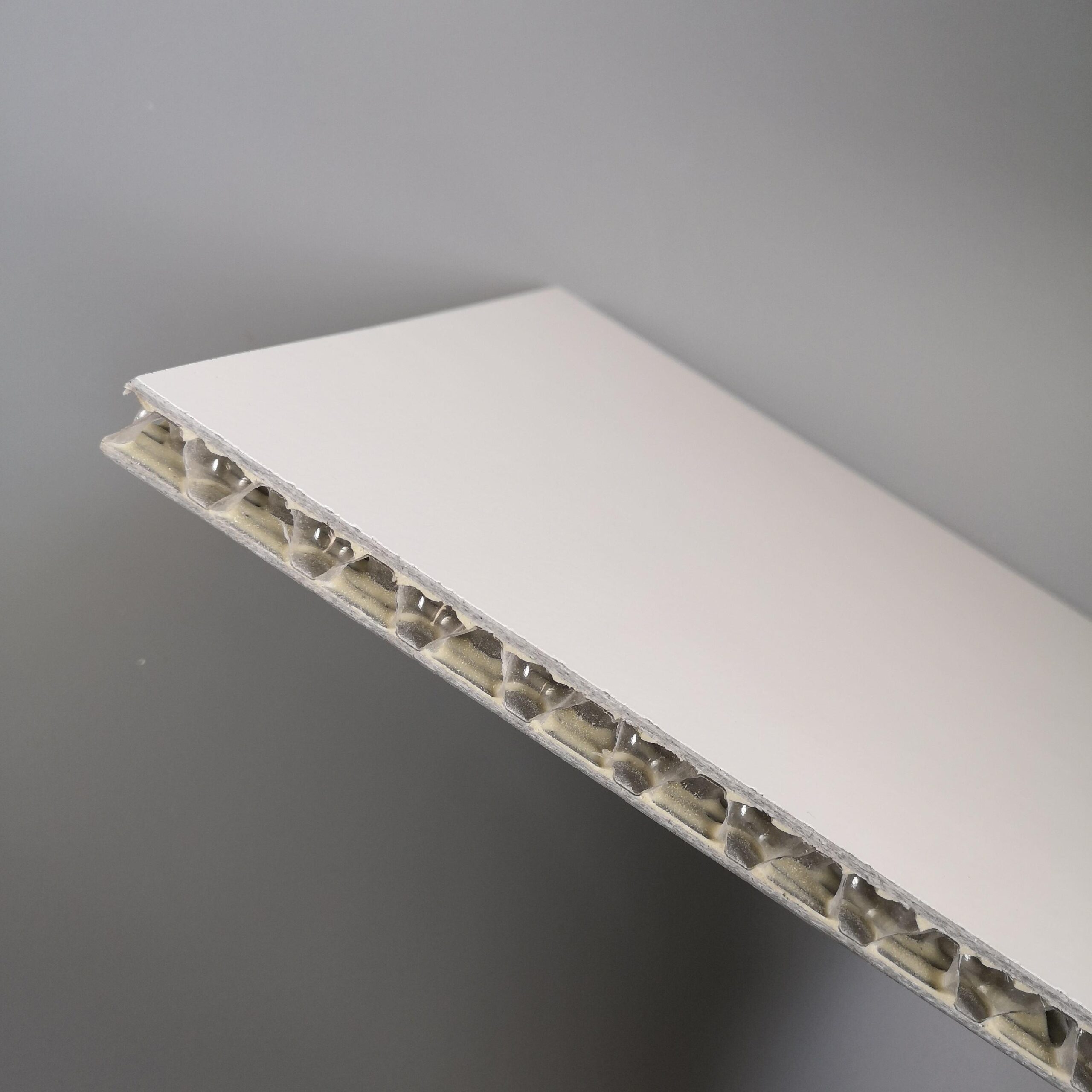
Selecting the right core material is one of the most important decisions in marine composite panel manufacturing. Boat builders, yacht manufacturers, and marine interior suppliers must balance structural strength, weight, moisture resistance, bonding performance, durability, and production costs.
Two materials that may be considered for marine sandwich panels are PP Honeycomb Core (Polypropylene Honeycomb Core) and PVC Foam Core (Polyvinyl Chloride Foam Core). Both can be incorporated into lightweight composite structures, but they have different cellular architectures and mechanical characteristics.
PP honeycomb core uses a cellular geometry consisting of interconnected walls, while PVC foam core consists of a cellular polymer foam structure. These differences affect how the materials transfer loads, interact with face sheets, and perform during manufacturing and service.
PP honeycomb core may be attractive for selected lightweight panels where low water absorption, thermoplastic material characteristics, and cellular structural efficiency are important. PVC foam core is widely used in marine composites because suitable grades offer established processing options and controllable mechanical properties.
However, neither material is universally superior. A core that performs well in a yacht cabinet door may not be suitable for a loaded boat deck or a structurally critical marine component.
This article compares PP honeycomb core and PVC foam core across material structure, mechanical properties, weight, moisture resistance, bonding, manufacturing, cost, and marine applications to help manufacturers make informed purchasing decisions.
2. What Is PP Honeycomb Core?
PP Honeycomb Core is a lightweight cellular material manufactured from polypropylene, a thermoplastic polymer.
Its internal structure contains interconnected honeycomb cells. This geometry reduces the amount of solid material required to occupy a given volume while providing a framework for supporting composite face sheets.
In a typical marine sandwich panel, PP honeycomb core is positioned between two face sheets, such as fiberglass-reinforced plastic (FRP).
The face sheets carry much of the tensile and compressive stress associated with bending, while the core maintains the separation between them and transfers shear loads.
Key Characteristics of PP Honeycomb Core
- Lightweight cellular construction.
- Low water absorption by the polypropylene material itself.
- Resistance to many forms of chemical attack and corrosion.
- Potential for customized cell geometry and core thickness.
- Compatibility with selected FRP and thermoplastic composite systems.
- Potential suitability for lightweight marine interior panels and other properly engineered components.
One important consideration is bonding. Polypropylene has relatively low surface energy, which can make adhesion difficult with conventional adhesives. Depending on the core grade and manufacturing process, surface treatment or a specially formulated adhesive may be necessary.
The structural properties of PP honeycomb core also depend on cell size, wall geometry, density, orientation, and manufacturing quality.
3. What Is PVC Foam Core?
PVC Foam Core is a cellular polymer material produced from polyvinyl chloride-based formulations.
In marine composites, structural PVC foam cores are commonly used between fiberglass or other composite face sheets to create lightweight sandwich structures.
Unlike PP honeycomb core, which has a defined honeycomb geometry, PVC foam core contains a cellular foam structure. Many structural PVC foam grades are designed with predominantly closed cells to help limit fluid penetration.
PVC foam cores are available in different densities and grades to meet different requirements for compression, shear, bending performance, and processing.
Key Characteristics of PVC Foam Core
- Cellular foam construction.
- Availability in different densities and thicknesses.
- Established use in many marine composite manufacturing processes.
- Potential compatibility with selected resin and adhesive systems.
- Mechanical properties that can be tailored through material grade selection.
- Suitability for a range of marine sandwich panel applications when properly specified.
PVC foam core is not a single uniform material. Mechanical performance, resin compatibility, temperature resistance, and chemical resistance vary by formulation and grade.
Manufacturers should therefore evaluate the technical data for the exact PVC foam core under consideration.
4. PP Honeycomb Core vs PVC Foam Core: Main Differences
The most fundamental difference between these materials is their cellular architecture.
PP honeycomb core uses a geometrically defined network of cellular walls. PVC foam core uses a cellular polymer matrix.
These structural differences influence the way each material responds to shear, compression, local loading, and bonding.
Technical Comparison Table
| Comparison Factor | PP Honeycomb Core | PVC Foam Core |
|---|---|---|
| Base material | Polypropylene | PVC-based polymer formulation |
| Cellular structure | Honeycomb geometry | Cellular foam structure |
| Density | Grade- and geometry-dependent | Available in multiple structural grades |
| Core shear behavior | Depends on cell geometry, wall properties, orientation, and density | Depends on foam density, formulation, and cell structure |
| Compression performance | Depends on core geometry and material properties | Depends on density, formulation, and grade |
| Water absorption | Polypropylene itself has low water absorption | Depends on foam grade, cell structure, and exposure conditions |
| Corrosion resistance | Polypropylene is not subject to electrochemical corrosion | Polymer foam core does not undergo metallic corrosion |
| Adhesion | May require surface treatment or a compatible adhesive | Depends on foam formulation, surface condition, and adhesive system |
| Local load support | May require inserts or reinforced areas | May require inserts or reinforced areas |
| Manufacturing | Requires a qualified bonding or thermoplastic processing system | Compatible with various established composite manufacturing processes |
| Customization | Depends on available core geometry, dimensions, and production capability | Depends on available grades, thicknesses, and processing capability |
| Cost | Depends on grade, production, processing, and order volume | Depends on grade, production, processing, and order volume |
This comparison identifies general material characteristics rather than guaranteed performance rankings. The actual result depends on the selected grade and complete sandwich panel design.
5. Density and Weight: Which Core Is Lighter?
Weight is an important consideration in boat and yacht manufacturing because the cumulative mass of interior panels, furniture, partitions, and equipment covers can influence the overall vessel weight.
However, comparing core density alone can produce misleading conclusions.
A lighter core may require thicker face sheets, additional reinforcements, or more substantial attachment structures to achieve the required mechanical performance.
For a meaningful comparison, manufacturers should calculate the mass of the complete panel rather than comparing only the core materials.
Example Core Weight Calculation
The theoretical core mass per square meter can be estimated using:
Core mass per unit area = Core density × Core thickness
Assume two illustrative core configurations:
- PP honeycomb core density: 80 kg/m³.
- PVC foam core density: 80 kg/m³.
- Core thickness for both materials: 20 mm, or 0.020 m.
The calculated core mass for each configuration is:
80 × 0.020 = 1.60 kg/m²
Example Comparison
| Parameter | PP Honeycomb Core | PVC Foam Core |
|---|---|---|
| Assumed core density | 80 kg/m³ | 80 kg/m³ |
| Core thickness | 20 mm | 20 mm |
| Calculated core mass | 1.60 kg/m² | 1.60 kg/m² |
| Face-sheet mass | Excluded | Excluded |
| Adhesive mass | Excluded | Excluded |
Important: This calculation compares only the theoretical mass of the core volume. It does not establish that the two materials have equivalent mechanical properties or that these densities represent commonly available grades from a particular supplier.
The appropriate comparison should use actual product specifications and verify whether each core meets the same design requirements.
How to Compare Complete Panel Weight
For a sandwich panel, estimated mass per unit area can be calculated as:
Panel mass = Upper face-sheet mass + Core mass + Lower face-sheet mass + Adhesive and reinforcement mass
This method provides a more realistic basis for evaluating PP honeycomb panels against PVC foam sandwich panels.
6. Mechanical Properties: Shear, Compression, and Bending
Mechanical performance is one of the most important factors in marine core material selection.
A sandwich panel may experience distributed loads, concentrated loads, bending, impact, vibration, and repeated loading during service.
Different mechanical properties describe different failure mechanisms.
6.1 Core Shear Strength
Core shear strength describes the core’s resistance to shear failure.
In a sandwich panel, the core transfers shear forces between the face sheets. If the core fails in shear, the panel may lose a significant portion of its structural capacity.
For PP honeycomb core, shear performance depends on the cell geometry, core orientation, wall thickness, material properties, and density.
For PVC foam core, shear performance depends on the foam formulation, density, cell structure, and manufacturing quality.
Buyers should request shear strength values and confirm the test direction and method before comparing products.
6.2 Compressive Strength
Compressive strength describes the material’s resistance to compression.
In marine panels, compression may occur beneath equipment supports, furniture fittings, fasteners, and other concentrated loads.
Honeycomb structures can respond differently depending on loading direction and cell geometry. PVC foam cores also exhibit grade-dependent compressive behavior.
For applications involving heavy fittings or point loads, manufacturers may need local reinforcement, load-spreading plates, solid inserts, or a different core configuration.
6.3 Bending Performance
The bending performance of a sandwich panel depends on the combined behavior of the core and face sheets.
Important variables include:
- Core thickness.
- Face-sheet thickness.
- Face-sheet tensile and compressive properties.
- Core shear strength and shear modulus.
- Bonding quality.
- Panel span and support conditions.
- Concentrated and distributed loading.
A thicker core can increase bending stiffness by separating the face sheets, but it may also increase panel thickness and require different attachment details.
The final design should be evaluated as a complete sandwich structure rather than inferred from a single core property.
7. Moisture Resistance in Marine Environments
Water exposure is a major consideration when selecting materials for boats and yachts.
Marine components may experience humidity, condensation, washing water, freshwater exposure, or direct seawater contact.
PP Honeycomb Core
Polypropylene itself has low water absorption. This can make PP honeycomb core attractive for applications where limiting moisture uptake by the core material is important.
However, water can still enter a finished panel through damaged skins, exposed edges, unsealed cutouts, fastener holes, or defective adhesive interfaces.
Therefore, low water absorption of the core should not be interpreted as proof that the complete panel is waterproof.
PVC Foam Core
Structural PVC foam cores are also used in moisture-exposed marine composite applications.
Their moisture performance depends on the foam grade, cell structure, face sheets, bonding system, and details of the finished panel.
As with PP honeycomb panels, exposed edges and damaged skins can compromise the integrity of the complete assembly.
Moisture Resistance Comparison
| Factor | PP Honeycomb Core | PVC Foam Core |
|---|---|---|
| Water absorption of base material | Polypropylene has low water absorption | Depends on the specific foam formulation and grade |
| Finished-panel waterproofing | Requires suitable skins, bonding, and edge protection | Requires suitable skins, bonding, and edge protection |
| Edge sealing | Important | Important |
| Fastener-hole protection | Important | Important |
| Long-term marine suitability | Requires application-specific validation | Requires application-specific validation |
For both materials, testing should reflect the actual panel construction and intended exposure conditions.
8. Bonding and Manufacturing Compatibility
Bonding is a critical issue when manufacturing composite sandwich panels.
Even when the core and face sheets have suitable mechanical properties, inadequate adhesion can cause delamination or reduce the effective performance of the complete panel.
8.1 Bonding PP Honeycomb Core
Polypropylene has relatively low surface energy, which can make it difficult to bond using some conventional adhesives.
Depending on the material and process, manufacturers may need:
- Plasma or corona surface treatment.
- A qualified chemical surface treatment.
- An adhesive formulated for polypropylene.
- Controlled adhesive application.
- Verified curing or consolidation conditions.
- Bond-integrity testing.
The exact requirements depend on the core grade, face-sheet material, and adhesive system.
8.2 Bonding PVC Foam Core
PVC foam core can be compatible with a range of marine composite manufacturing processes, depending on the foam grade and resin or adhesive system.
Nevertheless, compatibility should not be assumed.
The manufacturer must confirm that the selected resin or adhesive is suitable for the specific foam formulation and processing conditions.
Processing temperature, pressure, chemical exposure, and cure conditions may affect the foam or the interface.
Manufacturing Comparison
| Manufacturing Factor | PP Honeycomb Core | PVC Foam Core |
|---|---|---|
| Surface preparation | May require specialized treatment | Depends on foam grade and bonding system |
| Adhesive selection | Must account for polypropylene’s surface characteristics | Must be compatible with the selected foam |
| Core deformation risk | Depends on geometry and processing pressure | Depends on density, grade, temperature, and pressure |
| Process validation | Essential | Essential |
| Bond testing | Recommended or required according to the application | Recommended or required according to the application |
| Production efficiency | Depends on equipment and bonding method | Depends on equipment and established production process |
A supplier should be able to explain the recommended bonding process and provide supporting test data where available.
9. Marine Applications: Which Core Should You Choose?
The appropriate core material depends on the function of the component.
9.1 Yacht Interior Panels
For decorative wall panels, lightweight cabinet doors, and interior partitions, PP honeycomb core may be worth evaluating when low core water absorption and lightweight construction are priorities.
PVC foam core may be preferable where its available mechanical properties and existing processing methods better match the manufacturer’s requirements.
Both options require appropriate face sheets, bonding, and edge finishing.
9.2 Boat Deck Panels
Boat decks can experience concentrated loads, repeated foot traffic, impact, and environmental exposure.
Neither core should be selected solely on the basis of low density.
Manufacturers should evaluate core shear strength, compression performance, panel stiffness, face-sheet reinforcement, support spacing, fatigue resistance, and water ingress protection.
The selected panel should be validated against the relevant design loads.
9.3 Yacht Furniture and Cabinetry
Furniture panels often require a combination of low weight, surface quality, and reliable attachment of hinges, handles, and fittings.
PP honeycomb core can be considered for suitable lightweight furniture constructions.
PVC foam core may be selected where its mechanical properties or fabrication characteristics better meet the project requirements.
For both materials, local reinforcement may be needed around fasteners and concentrated loads.
9.4 Marine Bulkheads
The term “bulkhead” can refer to components with very different functions.
A lightweight decorative partition has different requirements from a watertight bulkhead or a structural bulkhead.
For non-critical interior partitions, either core may be considered if the completed panel meets the relevant requirements.
For watertight, fire-rated, or load-bearing bulkheads, the design must satisfy the applicable marine regulations and qualification requirements. Material selection alone does not establish compliance.
10. Cost Comparison: Beyond the Core Price
The purchase price per square meter or cubic meter is only one part of the total cost of a marine sandwich panel.
A complete cost assessment should consider the following factors:
| Cost Factor | Evaluation Method |
|---|---|
| Core material price | Compare equivalent dimensions and specifications |
| Face-sheet materials | Include the same functional requirements |
| Adhesive or resin | Account for actual consumption and material cost |
| Surface treatment | Include any additional preparation process |
| Labor | Compare preparation, assembly, curing, and finishing time |
| Reinforcements | Include inserts, edge sections, and local support |
| Manufacturing waste | Account for cutting losses and rejected panels |
| Quality control | Include inspection and required testing |
| Installation | Consider attachment methods and installation labor |
| Service life | Evaluate durability, maintenance, and repair requirements |
PP honeycomb core may require a specialized bonding process in some applications. PVC foam core may fit more readily into certain existing composite production systems.
However, the actual cost difference depends on the specific materials, process, production volume, and supplier quotation.
A reliable comparison should use prototype panels or validated production data rather than general assumptions about which material is cheaper.
11. Technical Testing and Quality Control
Core materials and finished panels should be evaluated using appropriate test methods.
The following ASTM standards are examples of methods that may be relevant to sandwich core and panel evaluation.
| Standard | Test Area | Purpose |
|---|---|---|
| ASTM C365/C365M | Flatwise compressive properties of sandwich cores | Evaluates resistance to compression through the core thickness |
| ASTM C273/C273M | Core shear properties | Evaluates core shear strength and shear modulus |
| ASTM C393/C393M | Flexural properties of sandwich constructions | Evaluates sandwich beam behavior under bending |
| ASTM D7249/D7249M | Facesheet properties of sandwich constructions | Evaluates face-sheet behavior under specified flexural loading |
| ASTM D7766/D7766M | Damage resistance of sandwich constructions | Supports assessment of damage resistance using specified procedures |
The applicable standard, specimen preparation, test conditions, and reporting requirements must be confirmed for the actual material system.
A meaningful comparison requires equivalent test methods and comparable specimen configurations.
For marine applications, additional testing may be needed for water exposure, environmental conditioning, fatigue, impact, bonding durability, and fire performance.
12. Practical Selection Checklist for Marine Manufacturers
Before choosing PP honeycomb core or PVC foam core, manufacturers should answer the following questions.
Application requirements
- Is the component decorative, semi-structural, or load-bearing?
- Will it be exposed to freshwater, seawater, condensation, or repeated washing?
- Does it need to meet specific fire or smoke requirements?
Mechanical requirements
- What are the expected distributed and concentrated loads?
- What are the maximum permitted deflection and panel thickness?
- Is impact or fatigue resistance important?
- Are local reinforcements needed around fittings?
Manufacturing requirements
- Which face-sheet materials will be used?
- Is the existing adhesive compatible with the selected core?
- Is surface treatment required?
- Can the production line maintain the required bonding quality?
Procurement requirements
- Are complete technical data sheets available?
- Can the supplier provide relevant test reports?
- Are dimensions, tolerances, and density clearly specified?
- Can prototype panels be manufactured and evaluated?
Answering these questions before requesting quotations can improve material selection and reduce manufacturing risks.
13. Conclusion
PP Honeycomb Core and PVC Foam Core are two different options for marine sandwich panel manufacturing.
PP honeycomb core offers a thermoplastic cellular structure with low water absorption of the base polymer and potential advantages in selected lightweight composite applications. Its bonding requirements and geometry-dependent mechanical behavior must be considered during design.
PVC foam core offers a cellular foam structure with a range of available grades and established use in marine composite manufacturing. Its suitability depends on density, mechanical properties, formulation, resin compatibility, and the intended service conditions.
For boat and yacht manufacturers, the best choice is not necessarily the material with the lowest density or lowest purchase price. It is the material that meets the required structural performance, environmental durability, manufacturing compatibility, and total cost targets.
A reliable selection process should compare verified technical data, calculate complete panel weight, validate bonding, and test the finished structure under representative operating conditions.
Looking for PP Honeycomb Core or PVC Foam Core for Marine Composite Panels?
ONEBOND can evaluate project-specific requirements for lightweight composite core materials. When requesting a quotation, provide the intended application, target density, core thickness, required mechanical properties, face-sheet material, manufacturing method, and environmental conditions.
These details help determine which core material and panel configuration best match your marine manufacturing project.
