
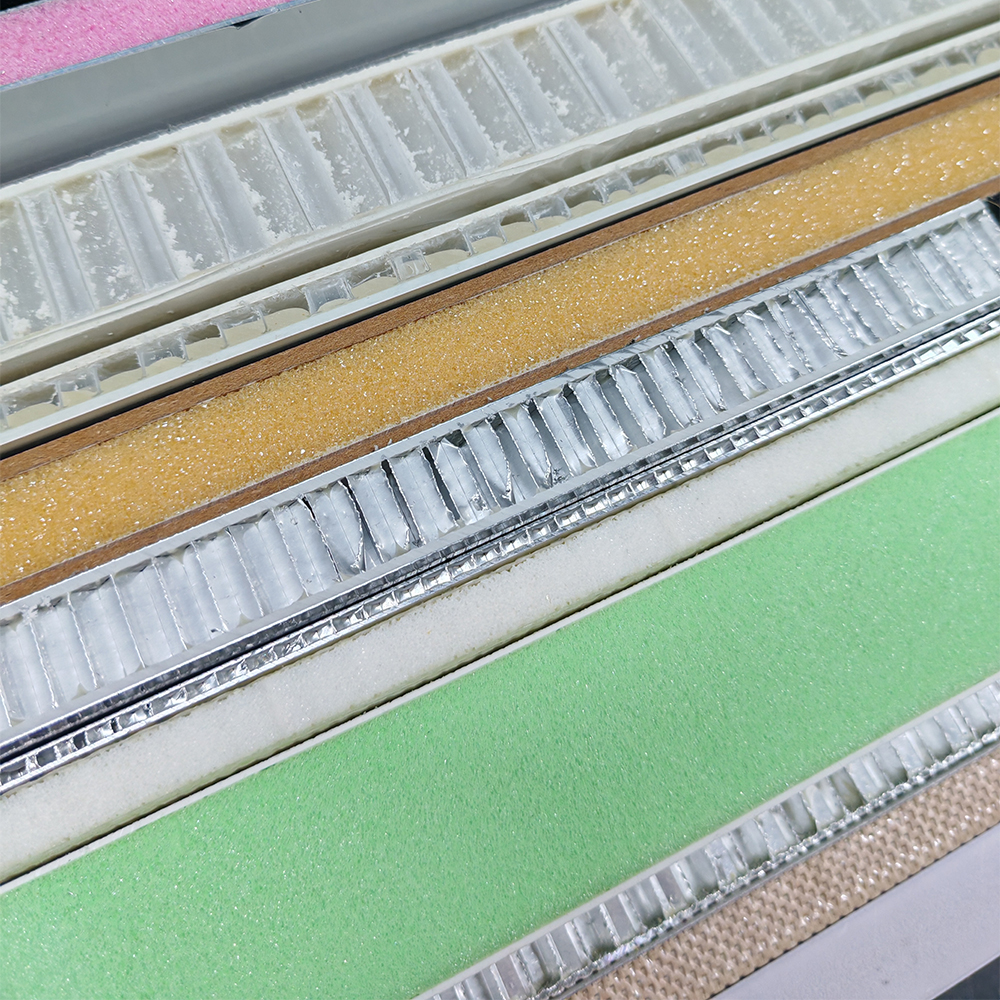
1. SAN Foam Core: A Structural Material Designed for Demanding Loads
SAN Foam Core, also known as Styrene Acrylonitrile Foam Core, is a high-performance polymer foam used in structural composite sandwich panels. It is manufactured from styrene-acrylonitrile copolymer and engineered into a lightweight, predominantly closed-cell structure.
Unlike conventional insulation foams, structural SAN foam is designed to transfer mechanical loads between composite face sheets. It provides core shear resistance, supports the face sheets against local deformation and helps maintain the geometry of the sandwich structure.
SAN foam is particularly relevant to applications exposed to repeated loading, impact and demanding environmental conditions. These include wind turbine blades, marine structures, offshore equipment and other large composite components.
Its engineering value is not simply its compressive strength. SAN foam is especially interesting because of its combination of tensile properties, shear deformation capacity, impact tolerance and fatigue performance.
For manufacturers of large composite structures, these properties can influence not only initial structural strength but also long-term service reliability.
2. Polymer Structure: What Makes SAN Foam Different?
SAN is a copolymer formed from styrene and acrylonitrile. The relative proportions of the two monomers influence stiffness, toughness, thermal behavior and other polymer properties.
In structural foam manufacturing, the polymer is processed into a cellular material with a controlled density and cell structure.
The resulting foam consists of polymer cell walls surrounding gas-filled cells. Its mechanical performance depends on several factors:
- Polymer composition and molecular structure
- Cell size and cell-wall thickness
- Cell uniformity and closed-cell content
- Density and density distribution
- Manufacturing and expansion conditions
- Crosslinking or other formulation-specific modifications
An important technical distinction is that not every SAN foam has an identical polymer architecture. Commercial structural grades may use different formulations and processing routes. Therefore, properties reported for one SAN product family should not automatically be applied to another.
2.1 Tensile Behavior and Structural Toughness
One of the important characteristics of structural SAN foam is its tensile behavior.
In a sandwich structure, the core is not only subjected to compression. It also experiences shear, local tension and complex stress states, particularly around blade roots, panel transitions, inserts and areas exposed to dynamic loading.
A core with adequate tensile strength and deformation capacity can help resist crack initiation and delay the development of certain damage mechanisms.
However, tensile strength alone does not define toughness. Engineers should also consider elongation, fracture resistance, shear deformation and the interaction between the core and face sheets.
2.2 Closed-Cell Structure and Moisture Management
Structural SAN foam commonly uses a closed-cell architecture.
This limits fluid penetration compared with open-cell foam, but it does not make the complete composite panel automatically waterproof.
Water ingress can still occur through damaged face sheets, exposed edges, drilled holes, poorly sealed joints or adhesive defects.
For marine and offshore applications, edge sealing and laminate integrity remain essential design requirements.
3. The Engineering Advantage: Fatigue Resistance Under Repeated Loading
Fatigue is one of the most important considerations when designing long-life composite structures.
A material may perform well in a single compression or shear test but experience progressive damage when subjected to thousands or millions of repeated load cycles.
This difference is particularly important in wind turbine blades.
3.1 Why Wind Turbine Blades Need Fatigue-Resistant Core Materials
Wind turbine blades experience continuously changing mechanical loads during operation.
The main sources include:
- Aerodynamic pressure fluctuations
- Gravity-induced cyclic loading as the blade rotates
- Wind turbulence and changing wind direction
- Start-up and shutdown cycles
- Emergency braking and transient operating conditions
- Local stress concentrations around structural transitions
These loads create repeated bending, shear and compression within the blade sandwich structure.
The core material must maintain its structural integrity while transferring shear between the blade’s composite skins.
If the core gradually develops cracks, loses shear stiffness or separates from the face sheets, the blade’s structural response can deteriorate.
3.2 Fatigue Is More Than a Strength Measurement
Fatigue performance should not be evaluated using static compressive strength alone.
A more complete assessment considers:
Fatigue life: The number of load cycles a material or structure can withstand under a defined loading condition.
Stiffness degradation: The reduction in elastic stiffness as internal damage develops.
Residual strength: The remaining load-bearing capacity after cyclic loading.
Damage initiation: The stress or strain level at which the first measurable damage occurs.
Damage propagation: The rate at which cracks, cell-wall damage or interface separation develops.
For SAN foam, these parameters depend on density, loading direction, stress ratio, frequency, temperature, moisture and the surrounding laminate construction.
Consequently, a fatigue-life value is meaningful only when the test conditions and specimen configuration are clearly identified.
3.3 Why SAN’s Deformation Capacity Matters
Some structural foam materials exhibit relatively limited deformation before failure. Others can accommodate more deformation and develop progressive damage.
A more deformation-tolerant core may redistribute local stresses and delay catastrophic structural failure under certain loading conditions.
Research into polymeric foam cores under water-slamming loads has demonstrated that higher-elongation foams, including tested SAN grades, can exhibit improved dynamic shear performance relative to their quasi-static properties.
This does not mean that SAN always has the highest strength. It demonstrates why loading rate and deformation capacity must be considered alongside static strength.
For wind turbine blades, the relevant design question is not simply which core has the highest compression value, but which material maintains sufficient structural performance throughout the expected operating life.
4. Mechanical Performance: How to Read SAN Foam Core Specifications
The following properties are particularly important when comparing SAN foam grades.
| Parameter | Engineering significance | Why manufacturers should evaluate it |
|---|---|---|
| Density | Mass per unit volume | Weight and structural efficiency |
| Compressive strength | Resistance to through-thickness compression | Local support and crushing resistance |
| Compressive modulus | Stiffness under compression | Deformation control |
| Shear strength | Resistance to core shear failure | Sandwich-panel load transfer |
| Shear modulus | Elastic stiffness under shear | Panel deflection and structural response |
| Shear elongation | Deformation before shear failure | Toughness-related behavior |
| Tensile strength | Resistance to tensile loading | Core integrity under complex stress |
| Tensile modulus | Stiffness under tensile loading | Structural deformation |
| Water absorption | Water uptake under defined test conditions | Environmental durability |
| Heat distortion temperature | Temperature-related deformation characteristic | Processing and service assessment |
Representative Mechanical Data for SAN Foam
The following data are based on the published Gurit Corecell M structural foam technical data sheet. They illustrate the relationship between density and mechanical properties across five SAN foam grades.
| Property | M60 | M80 | M100 | M130 | M200 |
|---|---|---|---|---|---|
| Nominal Density (kg/m³) | 65 | 85 | 107.5 | 140 | 200 |
| Density Range (kg/m³) | 61–69 | 81–89 | 100–115 | 130–150 | 185–215 |
| Compressive Strength (MPa) | 0.69 | 1.16 | 1.72 | 2.58 | 4.40 |
| Compressive Modulus (MPa) | 48 | 78 | 112 | 169 | 317 |
| Shear Strength (MPa) | 0.78 | 1.15 | 1.47 | 1.96 | 2.95 |
| Shear Modulus (MPa) | 23 | 34 | 44 | 60 | 98 |
| Shear Elongation at Break (%) | 57 | 57 | 50 | 40 | 30 |
| Tensile Strength (MPa) | 1.21 | 1.74 | 2.23 | 3.00 | 4.29 |
| Tensile Modulus (MPa) | 67 | 98 | 134 | 186 | 334 |
| Thermal Conductivity (W/m·K) | 0.03 | 0.04 | 0.04 | 0.04 | 0.04 |
| Heat Distortion Temperature (°C) | 110 | 110 | 110 | 110 | 110 |
Data interpretation: The values above are manufacturer-published typical specifications for the identified Corecell M product family. They are not ONEBOND guaranteed values or universal properties of all SAN foam products. Test methods, grade formulations and revisions can affect the reported values. The shear elongation values, for example, should not be interpreted as fatigue-life measurements.
The data illustrate two important engineering trends:
- Higher-density grades generally provide greater compression, shear and tensile strength.
- Lower-density grades can provide greater shear deformation before failure, depending on the formulation.
This means that choosing the highest-density grade is not automatically the best solution. Weight, stiffness, deformation capacity and structural requirements must be evaluated together.
5. Dynamic Loading and Impact Resistance: Beyond Static Laboratory Tests
Wind turbine blades are not the only composite structures exposed to dynamic loads.
Marine hulls, offshore structures, transportation panels and protective sandwich structures may experience impact, vibration or sudden loading.
SAN foam has been investigated in these environments because of its deformation capacity and damage tolerance.
5.1 Evidence from Sandwich Panel Impact Research
A 2014 study published in Procedia Engineering compared GFRP sandwich panels containing SAN, PVC and PMI foam cores under full-scale air-blast loading.
The study reported that the SAN-core sandwich panel experienced the least core damage among the three tested panel configurations. It also retained more structural stiffness, resulting in lower measured deflection.
This is useful evidence of the potential damage tolerance of SAN sandwich structures under a particular blast-test configuration.
However, the result should not be generalized to every SAN, PVC or PMI grade. Panel construction, face-sheet thickness, core density, bonding system and loading conditions all influence the outcome.
5.2 Impact Damage and Residual Strength
Impact resistance is also important because composite structures may sustain damage that is not immediately visible from the outside.
A 2018 study on sandwich composites examined residual bending behavior after low-velocity impact. In the tested configurations, SAN and PET cores showed progressive core shear cracking, while the balsa specimens exhibited a different failure response.
The study reported different reductions in initial bending stiffness and collapse force after impact.
The engineering lesson is that impact damage tolerance should be evaluated using residual structural performance, not simply the appearance of the panel after an impact.
6. SAN Foam Core in Wind Turbine Blade Manufacturing
Wind energy is one of the most important application areas for structural SAN foam.
Modern wind turbine blades require lightweight materials with sufficient stiffness, fatigue resistance and manufacturing compatibility.
SAN foam can be used in selected blade sandwich structures where its mechanical and processing characteristics meet the design requirements.
6.1 Blade Shell Sandwich Structures
A typical sandwich section consists of:
- Glass-fiber-reinforced polymer or carbon-fiber-reinforced polymer face sheets
- Structural SAN foam core
- Compatible resin and adhesive systems
The face sheets carry most of the bending-related tensile and compressive stresses, while the foam core maintains their separation and transfers transverse shear.
The core also helps stabilize the face sheets and resist local deformation.
6.2 Shear-Web and Structural Transition Regions
Wind turbine blades contain several regions with different structural requirements.
The root region, shell panels, shear webs and local reinforcement zones experience different combinations of loading.
Core density and thickness should therefore be selected according to local stress distribution rather than applying one grade throughout the blade.
High-density grades may be required around concentrated loads or structural transitions, while lower-density grades may be suitable for other regions where weight reduction is more important.
6.3 Infusion and Resin Compatibility
SAN foam grades can be designed for compatibility with commonly used polyester, vinyl ester and epoxy resin systems.
For vacuum infusion, core surface treatment and cutting patterns influence resin flow and the quality of the laminate.
Common core configurations include:
- Plain sheets
- Scored or grooved sheets
- Perforated sheets
- Double-cut or grid-scored sheets
- Contoured and CNC-machined components
These formats can help accommodate curved surfaces, improve resin distribution and reduce manufacturing difficulties.
However, cutting patterns should be selected according to the actual infusion strategy. Excessive resin channels or unnecessary perforation may increase resin consumption and finished component weight.
7. SAN vs. PVC vs. PET vs. PMI: Choosing the Right Structural Foam
The four materials are all used in composite sandwich structures, but their engineering priorities differ.
| Material | Main characteristics | Typical selection priorities |
|---|---|---|
| SAN Foam Core | High deformation capacity, toughness and fatigue-oriented structural performance | Dynamic loads, impact tolerance and demanding sandwich structures |
| PVC Foam Core | Established structural foam with broad density and processing options | General-purpose marine, wind and transportation panels |
| PET Foam Core | Thermoplastic foam with recycling potential and a broad structural application range | Lightweight panels, manufacturing efficiency and sustainability |
| PMI Foam Core | High-performance structural foam with grades suitable for demanding elevated-temperature processes | Aerospace and advanced composite structures |
SAN vs. PVC
SAN is often considered where higher deformation capacity and dynamic loading performance are important.
PVC is widely used as a general-purpose structural foam and offers a broad range of grades for composite manufacturing.
The choice depends on loading conditions, cost, processing requirements and the required mechanical properties.
SAN vs. PET
PET is attractive because of its thermoplastic nature and recycling potential.
A 2022 comparative study examined PET T92, PVC H60 and SAN T400 foam cores in terms of mechanical properties, thermal stability, resin uptake and cellular morphology.
The study reported that the tested PET grade could provide mechanical performance comparable to the selected PVC and SAN references, while offering advantages in the other evaluated areas.
This demonstrates that PET is a serious alternative in some structural applications, but the suitability of substitution must be confirmed using the actual grades and complete panel design.
SAN vs. PMI
PMI foam is often selected for high-performance applications requiring specific thermal processing and structural characteristics.
SAN may be more attractive where deformation capacity, impact tolerance and cost-performance balance are central considerations.
Neither material is universally superior. Engineers should compare mechanical properties at equivalent density and under the same testing conditions.
8. Manufacturing and Quality Control: Factors That Affect Final Performance
The quality of SAN foam core depends on polymer formulation, foaming conditions and cell-structure consistency.
For composite manufacturers, the following production and inspection factors are important:
Density uniformity: Large density variations can cause inconsistent structural behavior across a panel or blade component.
Cell morphology: Cell size and wall thickness influence mechanical performance and resin interaction.
Dimensional stability: Thickness, flatness and dimensional tolerances affect laminate quality and final panel geometry.
Surface condition: The core surface must be suitable for the selected resin and adhesive system.
Cutting accuracy: CNC machining and contour cutting should meet the required component geometry.
Resin uptake: Excessive resin absorption increases finished weight and manufacturing cost.
Bonding quality: Core-to-skin adhesion must be verified under the intended production and service conditions.
For critical applications, inspection should extend beyond the raw foam. Mechanical testing of the complete sandwich panel is necessary to verify the combined performance of the core, face sheets and interface.
9. How to Specify SAN Foam Core for Industrial Procurement
A professional procurement specification should contain more than a density target.
| Specification | Recommended Information |
|---|---|
| Material | SAN Structural Foam Core |
| Grade | Defined grade or equivalent approved specification |
| Density | Nominal density and allowable range |
| Thickness | Required finished thickness |
| Sheet Size | Length and width |
| Compression Strength | Test method and required value |
| Shear Strength | Test method and required value |
| Shear Modulus | Required stiffness |
| Shear Elongation | Required deformation capacity |
| Resin Compatibility | Polyester, vinyl ester or epoxy |
| Surface Treatment | Plain, grooved, perforated or double-cut |
| Processing Method | Vacuum infusion, hand lay-up or prepreg |
| Environmental Requirements | Temperature, moisture and fatigue conditions |
| Quality Documentation | Technical data sheet and test reports |
For wind turbine blade applications, additional requirements may include fatigue qualification, dynamic shear performance, impact resistance, process validation and traceability.
10. ONEBOND SAN Foam Core Solutions
ONEBOND focuses on composite core materials for industrial sandwich-panel manufacturing and lightweight structural applications.
SAN Foam Core is a specialized option for manufacturers evaluating core materials under repeated loading, impact and structural shear conditions.
Depending on actual product availability and manufacturing capability, buyers can discuss density, thickness, sheet dimensions, surface treatment, cutting patterns and processing requirements.
For technical evaluation, it is helpful to provide:
- Intended application, such as wind turbine blades or marine structures
- Required density and thickness
- Face-sheet material
- Resin system
- Manufacturing method
- Mechanical performance requirements
- Operating temperature and environmental conditions
For fatigue-sensitive applications, material selection should be supported by appropriate test reports and complete sandwich-panel validation.
11. Frequently Asked Questions
Q1: What is SAN Foam Core used for?
SAN Foam Core is used in structural composite sandwich panels for wind turbine blades, marine structures, offshore equipment and other applications requiring lightweight construction and good mechanical deformation characteristics.
Q2: Why is SAN Foam Core suitable for wind turbine blades?
Selected SAN grades offer a combination of shear strength, deformation capacity and fatigue-oriented performance that can be useful under the repeated mechanical loading experienced by wind turbine blades.
Q3: Is SAN Foam Core stronger than PVC Foam Core?
The answer depends on the density, grade and mechanical property being compared. SAN may offer advantages in certain tensile, impact or dynamic-loading conditions, while PVC remains a widely used general-purpose structural core.
Q4: Can SAN Foam Core be used for vacuum infusion?
Yes. Suitable SAN structural foam grades can be processed using vacuum infusion, provided the core surface configuration, resin system and infusion process are compatible.
Q5: What is the difference between SAN Foam Core and PET Foam Core?
SAN is often selected for its toughness and deformation characteristics in demanding structural applications. PET offers thermoplastic processing and recycling advantages. The appropriate choice depends on structural performance, manufacturing conditions and cost requirements.
Conclusion
SAN Foam Core is an important structural material for composite sandwich applications where mechanical toughness, deformation capacity and resistance to demanding loads are key considerations.
Its role in wind turbine blades illustrates why core-material selection must go beyond static compression strength. Fatigue behavior, dynamic shear response, impact damage tolerance and bonding durability all influence the long-term performance of composite structures.
For manufacturers, the most effective selection strategy is to evaluate SAN foam according to the actual load spectrum, manufacturing process and complete sandwich-panel design.
By combining the appropriate density, thickness, surface treatment and resin system, SAN Foam Core can contribute to lightweight composite structures designed for demanding industrial service.
